

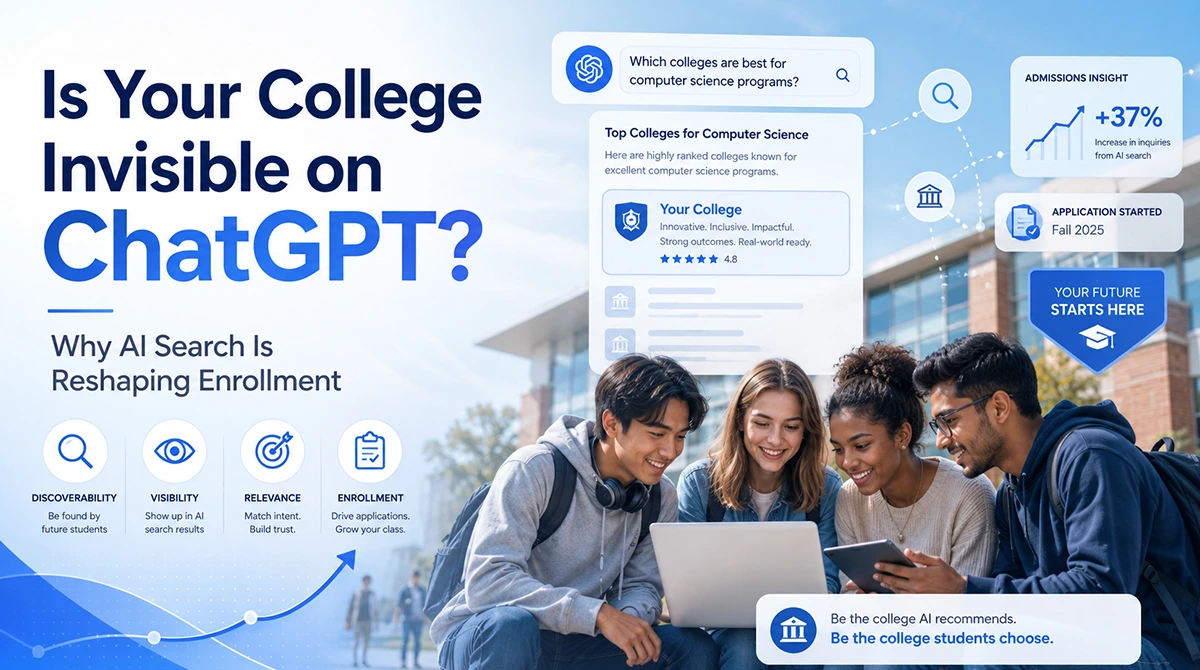
Ask ChatGPT for the best affordable nursing programs in your state, and it will name a handful of colleges in seconds. If yours is not one of them, the student never sees you. That is what AI search has done to the enrollment funnel. It has moved the first, decisive moment of discovery out of your admissions office and into a chatbot you cannot see.
For a fast-growing share of prospective students, the college shortlist is now built by an AI assistant before your team knows the student exists. And the assistant chooses which schools to name based on how clearly your content can be read and trusted, not on where you rank in Google. Here is what changed, why it matters more during an enrollment decline, and how to make sure your institution is in the answer.
THE SHORT VERSION
- ●Nearly half of high school students now use AI tools like ChatGPT in their college search, and almost one in five has dropped a college based on what AI told them.
- ●Ranking on Google no longer guarantees you are seen. AI assistants synthesize a single answer and name only a few schools.
- ●This is happening as the pool of students shrinks, so the cost of being missed is higher than it has ever been.
- ●AI visibility is engineered through clear, structured, consistent content. It is a fixable problem, and most institutions have not started.
What this article covers
- 1.The question students ask an AI before they ask you
- 2.Why ranking on Google no longer means you are seen
- 3.Why the timing is dangerous: the enrollment cliff
- 4.What being invisible on ChatGPT looks like
- 5.How colleges become visible and cited in AI answers
- 6.Why this is a leadership decision, not a tactic
- 7.Closing thoughts
- 8.Frequently asked questions
The question students ask an AI before they ask you
The college search used to start with a Google query or a mailer. Now it often starts with a prompt. Students ask in full sentences: “What are the best affordable business schools in Texas?” The AI replies with a short, confident shortlist, and that shortlist shapes everything that follows.
The questions are specific, and they are exactly the ones your program pages should be answering:
- ●“Which colleges in Pennsylvania have the best nursing pass rates?”
- ●“Compare these three schools for a first-generation student on a budget.”
- ●“What can I do with a communications degree, and which nearby schools are strong in it?”
- ●“Is [your college] actually worth the money?”
When your content answers those questions clearly, you get named. When it does not, the AI names a school that does. This is no longer an early-adopter habit. It is the norm for the students you recruit.
46% of students now use AI in their college search up from 26% just months earlier, per a national survey of 5,000+ high school students by the education firm EAB. And 18% said they removed a college from their list based on AI-generated results. Source: EAB
Read that second number again. Almost one in five prospective students has already crossed a school off the list because of an AI answer, usually before that school knew the student existed.
The behavior sits on a wider base. Pew Research Center found that roughly two-thirds of US teens already use AI chatbots, with ChatGPT the clear leader. For this generation, asking an AI is not a novelty. It is a reflex.
Why ranking on Google no longer means you are seen
For twenty years, the enrollment playbook was simple: rank on page one of Google, earn the click, get the visit. That foundation is eroding.
Traditional search volume: projected to fall 25% by 2026 as AI chatbots and answer engines absorb queries once run through Google, according to Gartner. The channel that carried your funnel is shrinking. Source: Gartner
Here is the part that surprises many leaders. Being visible in AI is not the same as ranking well in search.
Google’s AI Overviews and assistants like ChatGPT, Gemini, and Perplexity do not hand students ten blue links. They synthesize one answer from a few sources they judge to be clear, structured, and trustworthy, then name a few schools. You can hold the top spot for “nursing programs in Ohio” and still be left out, because your page was written to rank, not to be quoted.
The reason is mechanical. An answer engine has room to cite only a few sources, so it favors pages where the relevant fact is stated once, plainly, and matches what other trusted sources say. A page that makes the engine dig for your tuition or your pass rate loses to one that hands it over cleanly. Rank is about position. Citation is about clarity.
That gap is the move from SEO to answer engine and generative engine optimization. We break down the shift from SEO to GEO and AEO in more depth for teams that want the mechanics.
Why the timing is dangerous: the enrollment cliff
If this change were arriving during a demand boom, it would still matter. Instead, it is arriving at the worst possible moment.
US high school graduates peaked in 2025 and are projected to decline roughly 13%, close to half a million fewer per year, through 2041, with several states facing drops of 20% or more, per WICHE projections. The pool everyone recruits from is contracting. Source: Forbes, citing WICHE
Fewer students, discovered through a channel most colleges have not optimized for, is a compounding risk. When the pool grows, a weak digital presence costs you a little share. When the pool shrinks and the discovery layer changes at the same time, that weakness starts to threaten the budget.
The stakes are not hypothetical. Researchers at the Federal Reserve Bank of Philadelphia have modeled that a sharp enrollment drop could push up to 80 additional colleges to close, more than double the recent rate. For tuition-dependent institutions, visibility is no longer a marketing nicety. It is tied to survival.
Geography sharpens the point. The Northeast and Midwest face some of the steepest declines, so a school competing for a shrinking regional pool cannot afford to be the one an AI overlooks in favor of a rival two states away.
What being invisible on ChatGPT looks like
Invisibility rarely means your website is broken. It usually means a machine cannot cleanly understand, trust, or reuse your content when it tries to answer a student in one paragraph. In practice, it shows up as:
- ●Brochure pages, not answers. The facts students ask about, cost per year, program length, requirements, outcomes, are buried in marketing prose or missing.
- ●Inconsistent numbers. One tuition figure on the admissions page, another in a PDF, a third on a department site. That inconsistency makes you risky to quote.
- ●No structure. Little or no schema markup, so the engine has to guess what your pages mean.
- ●Hidden expertise. Your standout faculty, research, and program strengths are not expressed in terms a machine can read, so they never surface in the comparison.
- ●Someone else fills the gap. When your content is thin, the AI describes your school from a Reddit thread or a rankings site, sometimes with details that are outdated or wrong.
Each of these compounds quietly. A student rarely tells you they never applied because an AI skipped you. The loss shows up only as inquiries that never arrive. The danger is not only being absent. It is being present and described incorrectly, with no easy way to fix the record. We covered these failure modes for enrollment teams in our look at higher education marketing in the AI era.
How colleges become visible and cited in AI answers
The reassuring part is that AI visibility is engineered, not magic. Answer engines reward content that is clear, structured, consistent, and credible, which is what a well-run institution should want anyway. The work comes down to a few moves that reinforce each other:
- 1.Answer the real question, in the student’s words. Students ask “can I go part time?”, not “what are your flexible study pathways?” Put the direct answer near the top of the page, then add the detail.
- 2.Make the facts extractable and consistent. One authoritative page per key question, with cost, deadlines, and outcomes stated plainly and matching everywhere they appear.
- 3.Add structured data. Schema markup lets engines parse your programs, courses, and FAQs without guessing.
- 4.Prove credibility. Experience, expertise, and authority carry real weight, because when an AI can cite only a few sources, it picks the ones it trusts most.
If that sounds like a lot, start narrow. Pick the ten to twenty pages that drive real decisions, your flagship programs, admissions, tuition, and outcomes, and get those right first. That is usually enough to change how AI describes you, and it sets the pattern the rest of the site can follow.
Done well, the payoff is concrete. Instead of being absent, your institution appears as a named recommendation, with your own page as the cited source, in the exact moment a student is deciding where to apply. That is the difference between shaping the shortlist and never reaching it.
None of this means abandoning SEO. Search is still the eligibility layer that makes your pages discoverable in the first place. AEO and GEO sit on top and decide whether that content is the version an AI chooses to name. Run as one discipline, every improvement helps you across search results, AI Overviews, and chat assistants at once. Our answer visibility framework lays out the full approach.
See how your institution shows up in AI search today
Get a clear read on whether ChatGPT, Gemini, and Google AI Overviews are naming your programs, plus a practical plan to close the gaps. Built for enrollment and marketing leaders, not engineers.
→ Request an AI visibility AuditWhy this is a leadership decision, not a tactic
It is tempting to hand this to the web team as a project. That framing is exactly why many institutions will fall behind.
Being cited by AI is not a campaign. It is infrastructure. It depends on content operations, on data that stays consistent across systems, and on governance that keeps program pages, tuition, and faculty profiles accurate as they change. That work spans marketing, IT, admissions, and the academic units, so it needs an owner with the authority to align them.
In practice, the institutions that get this right name a single owner, often in enrollment marketing, and give them a mandate to set content standards across departments. Without that, program pages drift, answers contradict each other, and the AI is left to guess at which version of your school is true.
The institutions treating AI visibility as an enrollment priority now, rather than an IT ticket later, are the ones AI assistants will recommend in three years. The reverse is quieter but just as real. A college can run strong programs, price fairly, and support students well, and still watch its consideration set shrink because the machines that now mediate discovery cannot read it clearly.
For most institutions, closing that gap is less about spending more and more about organizing what already exists so it can be found and trusted. That is the core of what BinaryWorks builds into content and CMS architecture for higher education.
Closing thoughts
The debate about whether AI will change how students choose colleges is over. Nearly half already use it, many act on what it tells them, and the pool to compete for is shrinking at the same time.
The only open question is whether your institution is part of the answer or absent from it. Traditional search visibility no longer covers you, because the student increasingly never sees the search results. They see a synthesized recommendation, and either your programs are in it or they are not.
None of this is a reason to panic, and it is not a call to chase every new tool that appears. It is a call to treat the words on your most important pages as enrollment infrastructure, and to make sure they tell the same clear, credible story to a student, a parent, and a machine. That is a discipline you can start on this quarter, with the pages you already have.
This is solvable, and an early-mover advantage still exists because most institutions have not moved. Build clear, structured, credible content now, while the field is still forming, and you do more than defend enrollment against a demographic headwind. You position your institution to be the one the next generation’s most-used research tool recommends by name.
Frequently asked questions
Do prospective students really use ChatGPT to choose a college?
Yes. A 2026 national EAB survey of more than 5,000 high school students found 46% now use AI tools such as ChatGPT in their college search, up from 26% months earlier, and 18% had already removed a school from consideration based on AI results.
What is the difference between SEO, AEO, and GEO for higher education?
SEO makes your pages discoverable in traditional search. AEO (answer engine optimization) structures content so it can be lifted cleanly into direct answers and snippets. GEO (generative engine optimization) makes your content the source AI assistants choose to summarize and cite. They work best as one discipline, not three projects.
How do we know if our college is visible in AI search?
Ask the questions your students ask. Prompt ChatGPT, Gemini, Perplexity, and Google AI Overviews with real queries about your programs, cost, and outcomes, and see whether your institution is named, ignored, or described inaccurately. A structured AI visibility assessment does this across key programs and competitors.
Does traditional SEO still matter?
Yes. SEO is the eligibility layer that makes your content crawlable and discoverable. AEO and GEO build on it. The goal is not to replace SEO but to ensure your discoverable content is also the version AI engines trust enough to quote.
How long does it take to improve AI visibility?
It depends on your content, but the fastest wins come from fixing your highest-impact pages first, such as flagship program, admissions, and tuition pages, making the facts consistent and adding structure. Institutions that focus there often see movement in AI answers within a content cycle, not a full rebuild.
Which AI tools should we focus on?
Start with the ones your prospective students actually use. ChatGPT is by far the most common in college search, followed by Google’s AI Overviews and Gemini. Optimizing for clear, structured, credible content tends to help across all of them at once, so you are not betting on a single platform.
Is this only about undergraduate recruitment?
No. Graduate, online, and adult learners rely on AI search just as heavily, often more, because they research specific programs and outcomes on their own time. Any program that depends on being found and compared online faces the same shift.