

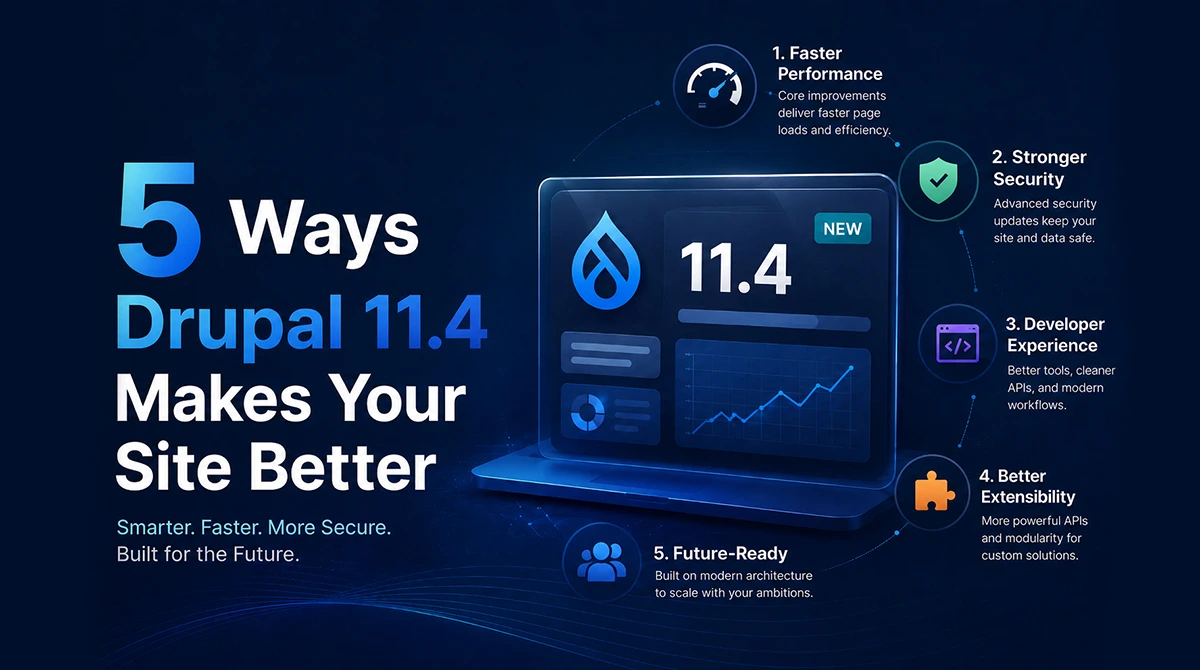
Every Drupal release raises the same boardroom question: is this one worth the disruption? For Drupal 11.4, the answer is unusually clear.
It is a minor release, so it does not break your public APIs or force a costly rebuild. Yet it delivers gains you can measure in speed, security, and staff hours.
Drupal.org’s official release announcement calls 11.4 the largest single leap in platform performance in ten years, the second release running to earn that billing. The five sections below translate that into what it means for your revenue, your risk, and your roadmap.
Short answer Drupal 11.4, released on July 1, 2026, is a low-risk minor upgrade that makes your site noticeably faster (roughly half the database queries of Drupal 11.3), tightens security with argon2id hashing and faster dependency patching, streamlines content editing, modernizes the codebase to reduce maintenance cost, and carries security support through June 2027. For most organizations already on Drupal 11, it is worth scheduling now.
Contents
- •Way 1: Faster performance that protects conversions and search rankings
- •Way 2: A stronger security posture with support locked to June 2027
- •Way 3: A better content experience that speeds up your team
- •Way 4: Lower maintenance cost from a cleaner, modern codebase
- •Way 5: A low-risk, well-timed runway to Drupal 12
- •Should you upgrade to Drupal 11.4?
- •Frequently asked questions about Drupal 11.4
- •Closing thoughts
Way 1: Faster performance that protects conversions and search rankings
Drupal 11.4 roughly halves the number of database queries a typical request makes versus Drupal 11.3.
Starting from a fully cold cache, an equivalent request now touches only about a third of the database and cache lookups that Drupal 11.0 or 10.6 would have needed. Drupal.org puts the real-world saving at several hundred milliseconds per request.
These gains land on the operations a busy site runs constantly: loading and listing content entities, handling translations, and rendering navigation.
Sites built on JSON:API see an outsized benefit, since the queries behind entity lists now rely on fewer joins and trigger fewer slow database calls.
A quick look at the headline numbers:
| Improvement | Measured gain (per Drupal.org) |
|---|---|
| Database queries vs. Drupal 11.3 | Reduced by about half |
| Database and cache lookups vs. 11.0 / 10.6 | About one-third of the previous total |
| Recipe-based installs (including Drupal CMS) | Roughly 2x faster |
| Translation update checks (66 projects, 38 languages) | 87% faster than 11.3 |
| CSS and JavaScript compression with Brotli | 15 to 25% smaller than gzip |
Why does this belong in a business case? Speed is a conversion lever, not just a technical metric.
Google’s research has long shown that a large share of visitors abandon a page that takes more than three seconds to load, and Core Web Vitals feed directly into search visibility.
The new Brotli compression support shrinks your CSS and JavaScript payloads by 15 to 25 percent over gzip, which means lighter pages and faster loads, especially on mobile.
If speed is a priority for your platform, our Drupal web development practice builds and tunes sites to take full advantage of these core gains.
Way 2: A stronger security posture with support locked to June 2027
Drupal 11.4 strengthens security in two concrete ways.
First, it adds a configurable, much stronger password hashing option called argon2id. Second, it lets sites apply critical dependency security patches immediately, instead of waiting for a full core release.
On top of that, the 11.4 branch is covered by security support until June 2027.
That second change is bigger than it sounds. Previously, tight version constraints in the core-recommended package meant an urgent fix in an upstream library such as Guzzle or Twig often could not be applied until the next Drupal release shipped.
Picture a serious vulnerability disclosed in a dependency like Guzzle late on a Friday. Under the old packaging rules, your team might have had to wait for the next Drupal release before shipping the fix. With 11.4, you can review and deploy it the same day and move on.
For regulated US organizations in healthcare, finance, government, and higher education, that responsiveness narrows compliance gaps and strengthens your audit trail.
If security is your first concern, a structured Drupal website security audit is the fastest way to see where your current version stands before you upgrade.
Way 3: A better content experience that speeds up your team
Drupal 11.4 tidies up the everyday editing and site-building experience.
New sites begin from a leaner default install, the admin interface now runs on the modern Navigation module, and content teams get cleaner tooling for managing how their content displays. The result is less friction for the people who publish your content day to day.
The Standard install profile no longer bundles unused Article and Page types or turns comments on by default, so fresh builds start cleaner.
The newer navigation replaces the legacy Toolbar, which is now scheduled for removal in Drupal 12. And a redesigned display-modes overview gathers every display for a content type onto one screen, which smooths the handoff to page builders.
Consider a marketing team publishing dozens of campaign pages a month. Shaving even a minute off each edit, and removing the clutter around it, compounds into real hours of recovered capacity across a quarter.
Editorial velocity is a competitive advantage, and pairing these gains with intentional experience design turns a cleaner admin into faster, on-brand publishing.
Way 4: Lower maintenance cost from a cleaner, modern codebase
Drupal 11.4 modernizes the codebase in ways that lower your long-term maintenance cost.
Core has shifted almost entirely to standard object-oriented PHP. Every core .theme file and 32 modules have been rewritten as PHP classes.
Routes can now be declared with PHP attributes instead of YAML, and an experimental native dr command line interface has been introduced to take over from the older, hardcoded tooling over time.
Why does this matter to a budget owner rather than a developer? Cleaner, more conventional code is cheaper to maintain, easier for dedicated Drupal developers to onboard into, and less prone to costly custom workarounds.
The move to standard Symfony patterns, including the new Symfony Runtime integration, means your platform tracks the wider PHP ecosystem instead of drifting into bespoke territory that only a shrinking pool of specialists understands.
The practical payoff is a lower total cost of ownership over the life of the site. Ongoing Drupal maintenance and support becomes more predictable when the underlying code follows modern, well-documented conventions.
Way 5: A low-risk, well-timed runway to Drupal 12
Upgrading to Drupal 11.4 is a low-risk step that also positions you well for Drupal 12, which arrives the week of December 7, 2026 alongside the Drupal 11.5 Long Term Support release.
Because 11.4 is a minor release that leaves public APIs intact, most standard sites can adopt it quickly and then plan the larger move to 12 on their own timeline.
The timing is worth planning around now. Drupal 11.5 will carry Long Term Support, with the version 11 line supported through the end of 2028.
That gives you a stable, well-supported foundation while you evaluate Drupal 12. Adopting 11.4 today keeps you current, extends your security window, and shortens the eventual jump to the next major version.
For US enterprises weighing that roadmap, the pattern our teams see across client engagements is consistent: organizations that stay close to the current minor release face far less disruption at each major upgrade than those that let versions stack up.
Should you upgrade to Drupal 11.4?
Yes, for most sites already on Drupal 11, upgrading to 11.4 is a low-risk, high-value move.
It is a minor release that keeps public APIs stable, extends security support to June 2027, and delivers performance and security gains straight away. The main area to review is any custom code, which should be checked against the release’s deprecations before deployment.
The calculus differs by starting point. If you are on Drupal 11.3, the move is quick and the benefits are noticeable right after deployment.
If you are on Drupal 9, 10, or an end-of-life version like Drupal 7, the path to the current release is a larger enterprise migration that deserves a proper scoping audit before you commit budget or a timeline.
Frequently asked questions about Drupal 11.4
What is new in Drupal 11.4?
Drupal 11.4 introduces major performance gains (about half the database queries of 11.3), Brotli compression for CSS and JavaScript, faster translation handling, stronger argon2id password hashing, faster security patching for key dependencies, a leaner default install with the modern Navigation module, and an experimental native dr command line interface.
When does Drupal 11.4 security support end?
The Drupal 11.4 branch receives security support until June 2027, according to Drupal.org. Drupal 11.3 is supported until December 2026.
How much faster is Drupal 11.4 than 11.3?
Drupal 11.4 reduces database queries by roughly half compared to Drupal 11.3 and makes recipe-based installs about twice as fast. On the same requests, it uses about one-third of the database and cache lookups that Drupal 11.0 or 10.6 required.
Is upgrading to Drupal 11.4 risky?
No. Drupal 11.4 is a minor release that preserves compatibility for the public APIs your custom code depends on, so most standard sites upgrade quickly. Internal APIs and experimental modules can still shift, so custom modules and themes should be reviewed against the release’s deprecations first.
When is Drupal 12 coming?
Drupal 12 is scheduled for the week of December 7, 2026, released alongside Drupal 11.5, which will be a Long Term Support version supported through the end of 2028.
Closing thoughts
Drupal 11.4 is not a flashy release, and that is exactly why it belongs on your roadmap.
It makes your site measurably faster, harder to breach, easier to publish on, cheaper to maintain, and better prepared for Drupal 12, all without breaking what already works.
For a decision maker, that is a rare combination: meaningful upside with minimal risk. The organizations that treat the current minor release as a standing habit, rather than a project they postpone, are the ones that avoid painful, expensive catch-up upgrades later.
Ready to turn Drupal 11.4 into a business advantage?
Get a fixed-scope Drupal 11.4 upgrade plan built around your platform, your risk profile, and your budget, so leadership has a defensible number before any work begins.
Talk to BinaryWorks about your Drupal 11.4 upgrade