

AI in higher education marketing is reshaping how prospective students discover, evaluate, and choose institutions. Universities that build AI visibility into their enrollment marketing strategy today will be the ones recommended by AI assistants tomorrow.
The way students discover, evaluate, and choose institutions has shifted faster than most university websites have adapted. AI in higher education marketing is no longer a future topic: per Pew Research Center, about two in three American teens are already using AI chatbots, and for a third of them it is a daily habit. These are your prospective students, and many will have formed an impression of your institution before they ever land on your homepage.
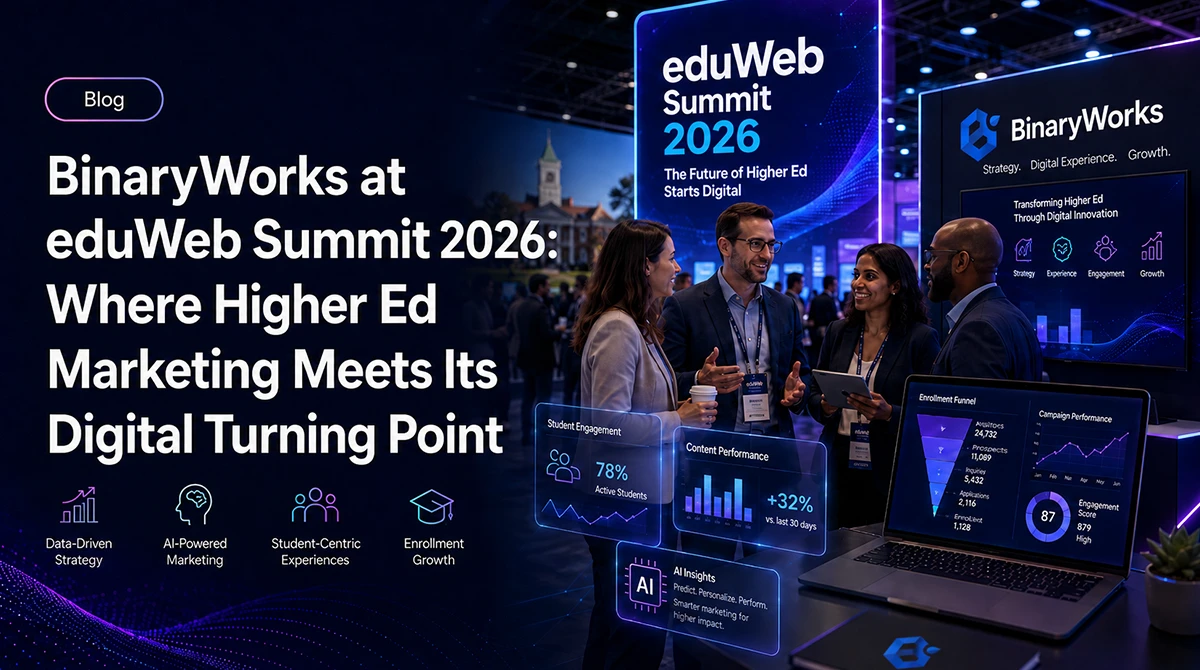
That is the conversation BinaryWorks is heading to Orlando to have. We work with higher education institutions on AI services, AI visibility, and digital strategy that connects enrollment marketing to outcomes that matter.
Sathish Kumar Mariappan, Shawn, and John Harris will be at Booth 29 throughout the summit, meeting enrollment marketing and digital teams navigating the two challenges that now define every higher education recruitment conversation.
Why Does eduWeb Summit Matter for Higher Education?
eduWeb Summit is where enrollment marketing, web, and digital teams examine how student behavior is changing and what that means for institutional strategy. Peers facing the same pressures with real budgets and real constraints gather to compare what is actually working in higher ed digital strategy, not just what looks good in a pitch deck.
Student search behavior is evolving faster than enrollment marketing strategies are adapting. eduWeb is one of the few spaces where teams can step back from daily execution and honestly assess whether their digital engagement approach is keeping pace.
What Challenges Do Higher Education Institutions Face in Student Enrollment?
Higher education institutions are dealing with a range of pressures, but two pain points surface in almost every enrollment marketing conversation.
Student admission: getting found by the right prospective students
Enrollment pipelines depend on visibility, and visibility is getting harder to guarantee. Pew Research Center reports that more than half of teens (57%) now use AI chatbots to look things up.
When a prospective student asks an AI assistant which universities offer strong programs in their field, the answer is shaped entirely by how well your institution’s content can be read, structured, and cited by those systems. Traditional search rankings no longer tell the full story.
Gartner projects that traditional search engine volume will fall by roughly 25% by 2026 as AI assistants absorb more of that query traffic. Institutions that built their student recruitment funnels on search rankings are already feeling this. The ones investing in AI visibility and enrollment marketing strategy now are the ones AI will recommend.
Student success: keeping students once they enroll
Admission is only half the equation. Student success, helping enrolled students stay, progress, and complete their degrees, is where institutions are increasingly measured and funded.
Students who feel disconnected from their institution, through impersonal communication, hard-to-navigate portals, or gaps in support touchpoints, are more likely to stop out. The digital experience does not end at enrollment. For many students, the quality of digital engagement post-admission determines whether they persist.
How Is Technology Changing Higher Education Marketing?
Several shifts are converging in higher education digital strategy at once. Every enrollment marketing and web team should have these on their radar.
AI visibility: being found where prospective students actually search
Traditional search engine optimization was built for a world where students typed a query and clicked a link. That world is shrinking. AI assistants now synthesize answers and surface institutions without a click ever happening. Being visible in that environment requires structured content, clear institutional expertise signals, and answers that AI engines can extract and attribute. This is what AI visibility for higher education means in practice, and it is becoming foundational to student recruitment.
For a deeper look at how GEO and AEO work and what content teams need to change, our guide covers the shift in full. The short version: if your program pages, faculty profiles, and admissions content are not structured for AI extraction, you are invisible in the moment that matters most.
Personalization at scale in enrollment marketing
Prospective students expect the same tailored digital experience from a university that they get from every other platform in their lives. Delivering personalization at scale depends on connected data. When CRM, website behavior, and communication history sit in separate systems, personalization stays theoretical. The institutions closing this gap are treating data infrastructure as an enrollment marketing priority, not an IT project.
AI services for student success and retention
EDUCAUSE research shows that roughly eight in ten higher education professionals feel positive about AI’s potential in their work. The use cases delivering the clearest results: early academic risk identification, personalized outreach at key moments in the student lifecycle, and advisors spending less time on logistics and more time on genuine student support.
BinaryWorks has delivered these capabilities across the educational institutions, connecting AI to the enrollment and student success workflows that institutions already run.
What Does This Mean for Student Engagement and Enrollment?
Across all of these shifts, the higher education institutions gaining ground share one habit: they have stopped measuring what is easy and started measuring what matters.
The enrollment marketing strategy to apply it is what separates institutions that grow from institutions that report.
What Is BinaryWorks Bringing to Booth 29 at eduWeb Summit 2026?
BinaryWorks works with higher education institutions on AI services and AI visibility: helping universities become discoverable in the channels prospective students are actually using, and deploying AI to support students from inquiry through graduation.
Our work in education spans university digital platforms, enrollment-connected web experiences, and AI agent discoverability strategies to ensure institutions are surfaced when and where students search.
At Booth 29 we are offering every institution a concrete starting point.
We review your institution’s current visibility across AI-driven search surfaces and identify the specific gaps affecting your student recruitment funnel. No obligation. No pitch deck.
Visit us at Booth 29 to claim yours. July 14 to 16, Orlando.
Sessions We Are Running at Booth 29
Walk-ins welcome. 15-minute sessions. No registration required.
Find Us at Booth 29
Stop by Booth 29 at eduWeb Summit 2026 for your free AI Visibility Audit. Full details on our eduWeb Summit 2026 event page.
We will share our key takeaways from Orlando right here after the summit. For more on what BinaryWorks does for higher education institutions, visit our higher education industry page.