

AI Talks #7 with Bryan Alexander, futurist and Senior Scholar at Georgetown University
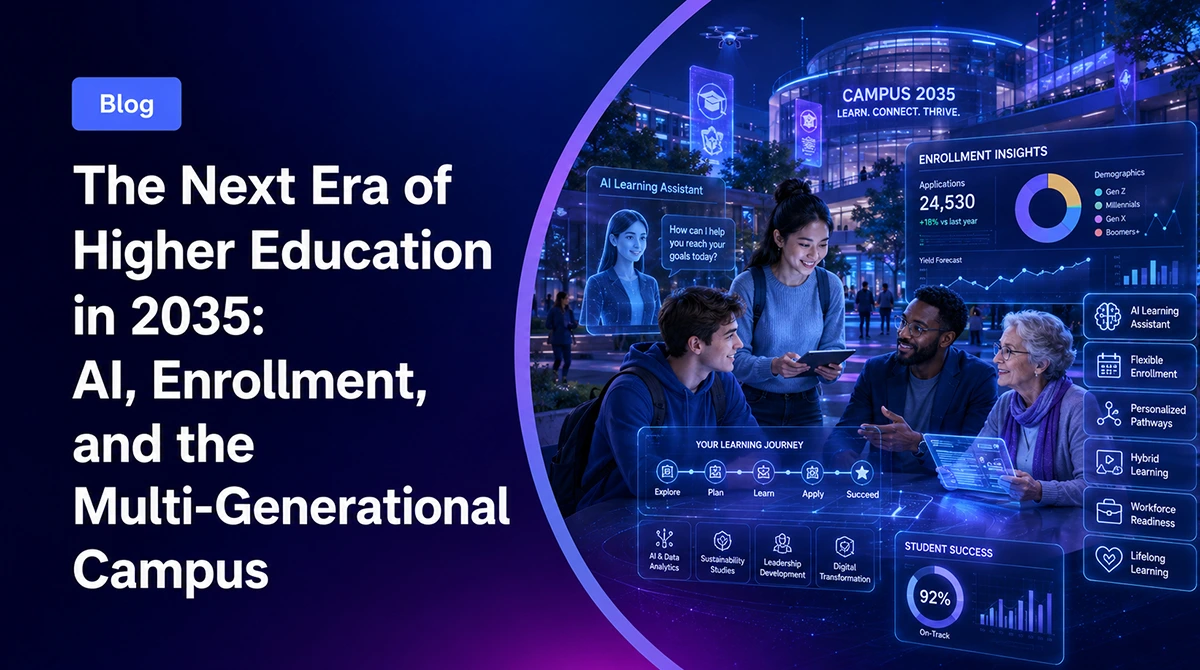
What does the future of higher education look like in 2035? According to futurist Bryan Alexander, it could break in wildly different directions: a campus where 19-year-olds and 90-year-olds learn side by side, or an academia shrunk to a tenth of its size because people decide AI is good enough. In this episode of AI Talks, host Sathish sat down with Alexander, a Senior Scholar at Georgetown University who studies higher education for a living, to map the forces reshaping it: demographics, AI, enrollment, the job market, and the human connection that may be the hardest thing to replace. The conversation stays close to how the two of them talked, with the key findings after each exchange.

Bryan Alexander
Bryan Alexander is a futurist, author, and Senior Scholar at Georgetown University. He helps colleges, universities, and education organizations understand the future of higher education and AI, advising leaders on teaching, learning, research, and the forces reshaping the modern campus and student experience.

Sathish Kumar Mariappan
Sathish Kumar Mariappan is Co-Founder of BinaryWorks, an Atlanta-based certified Drupal agency. He helps education, government, healthcare, and enterprise organizations with Drupal development, migration, AI consulting, and digital strategy, building secure, scalable digital experiences across complex ecosystems.
Episode TL;DR
Short on time? Here is the whole conversation in a glance:
- 2035 is a fork, not a forecast. A shrinking pipeline of 18-year-olds could push campuses to serve adults and elders, creating a multi-generational student body.
- Two AI scenarios. Either academia shrinks to a tenth of its size as people accept AI as good enough, or AI stays unsettling and the human classroom becomes the premium choice.
- AI is at least as big as the internet, with limits still unknown. Asia and the Middle East are excited; the US “helped invent AI and hates it the most.”
- Most schools are unprepared. A survey found only about 23 percent of US colleges had an AI policy, much less a strategy.
- “Peak higher education.” US enrollment grew from 1980 to 2012, topped out near 21 million students, slid for years, and has rebounded to about 18 million.
- Assessment is “a nightmare.” Detectors like Turnitin and GPTZero misfire, and the sector has to rethink assessment from top to bottom.
- Critical thinking is the gym test. AI can lift the weights for you, or spot you while you grow. Design for the second.
- Three futures of work: net job growth, underemployment, or AI “infusing” every job. Watch for a “white collar rust belt.”
- The best case: AI that augments students, researchers, and staff, with simulations and role-play as a favorite use.
Prefer to Listen? Stream the Full Episode on Spotify
A summary can only carry so much. The full conversation has the scenarios, the data, and the asides that make the forecast land. Press play for the complete discussion.
What Will Higher Education Look Like in 2035?
Sathish: “You’ve spent many years in higher education. Looking ahead to 2035, what do you see? What changes are coming across universities?”
Bryan: “Nine years out, there are a lot of possibilities to bear in mind. One is that most of the world is going through the demographic transition: fewer kids, adults living longer. It is happening across Europe, North and Central America, almost all of Asia, parts of Africa. For higher education it means the pipeline of traditional 18-year-olds gets tighter and tighter. Institutions that primarily serve that population start to shrink, close, or merge, or they pivot to teaching more adults, including more elders. Imagine a campus where 19-year-olds and 90-year-olds learn together.”
Bryan: “The second force is what AI does to higher education and the world. It is possible academia shrinks to maybe one-tenth its present size, because so many people find AI comparable or superior to the academic experience. It is also possible that in 2035 AI still feels strange and unsettling, and people say, I would rather take a class with a professor than listen to a bot, because I want the human experience.”
He added two more pressures: a warmer climate forcing campuses to adapt physically and to teach and research it harder, and deepening inequality that reframes what a degree is even for.
The future of higher education here is not a single prediction but a set of forces colliding. The demographic cliff is the most concrete: fewer 18-year-olds means the institutions built around them must change their audience or close. The multi-generational campus is the optimistic version of that math, turning a shortage of teenagers into a long-tail market of adult and older learners. AI, climate, and inequality then decide whether that pivot happens by design or by emergency.
Is AI Really as Big as the Internet?
Sathish: “Some people say AI is like the internet, more opportunity, not just disruption. Is this another wave like the internet?”
Bryan: “At the very least, AI is as powerful a force as the internet. Think about everything built on top of it: the web, mobile, the whole digital economy. AI might be that powerful. I say might because it is fluid. We may hit the limits of large language models, or we may go beyond them toward something like artificial general intelligence. There is great polling showing Asia and parts of the Middle East are very excited about AI, while English-speaking countries, especially the United States, are skeptical. The joke I have heard is that the US helped invent AI and hates it the most.”
Treating AI as merely a tool understates the stakes. Positioning it next to the internet reframes it as a general-purpose force that reshapes culture, work, and institutions over decades, not a feature to bolt onto a syllabus. The geography of attitudes matters too: where AI in higher education is met with excitement, adoption compounds, and where it is met with suspicion, the gap widens.
What Trend Is Higher Education Missing?
Sathish: “What is one trend management is missing and should act on immediately?”
Bryan: “Academia as a whole is struggling to get its arms around AI. I see very basic reactions, faculty returning students to handwriting or oral recitation. A survey last year found only about 23 % of American colleges had an AI policy, much less a strategy, years after AI took off. We need to deploy all of our intellectual firepower to understand this, and I do not mean an uncritical embrace, quite the opposite. Bring in psychologists on what it means to use AI as a friend or therapist, economists on the labor market, historians and political scientists on how states use AI in war.”
Bryan: “The comparison I make, which people do not love, is COVID. In 2020, universities reacted energetically: ad hoc teams, emergency procedures, transformed curricula and physical spaces, a lot of data production. AI is at least that powerful a challenge, and we need to pivot that far.”
The missed trend is not AI itself but the tepid response to it. An AI policy is table stakes, and roughly three-quarters of institutions lack even that. The COVID analogy is the useful provocation: universities have already proven they can reorganize fast under pressure, so the capacity exists. What is missing is the decision to treat AI in higher education as that level of challenge rather than a passing IT issue.
What Is “Peak Higher Education”?
Sathish: “Your January 2026 book talks about peak higher ed. What do you mean by peak?”
Bryan: “It refers to American higher education, which differs from the rest of the world. Enrollment grew from about 1980 to 2012, a huge increase, maxing out around 21 million students. Then for nine years it declined a little each year, and a lot more during the pandemic. We have rebounded to about 18 million, still below the peak. Attitudes have soured: people think higher ed is too political, too expensive, or not worth a job. The current administration’s stance on immigration has reduced international students, and most American colleges depend on tuition, so when students decline, money declines. Almost every college that has cut programs or closed in the past three years cites declining enrollment. The national consensus around college for everyone has broken, with no replacement.”
Bryan: “Peak has a second meaning too, like a peak experience, something excellent. We can rethink and rebuild American higher education to be awesome and attract more students and teach them better. That is the optimistic note I end on.”
Peak higher education names a real inflection point in higher education enrollment: the long postwar climb has stalled, and the tuition-dependent model turns every enrollment dip into a budget crisis. The deeper issue is the collapse of the “college for everyone” consensus without anything to replace it. The hopeful reading is that “peak” can mean best, not just highest, which puts the burden on institutions to redesign the experience rather than wait for demographics to rescue them.
Watch the Full Conversation on YouTube
Reading the highlights is one thing. Watching Bryan Alexander reason through the scenarios in real time is another, including the moments that do not fully translate to text.
How Is AI Changing Teaching and Personalized Learning?
Sathish: “Traditional teaching may be obsolete. How will AI change teaching and students’ lives?”
Bryan: “Most students have access to AI and use it in different ways: producing content for classes, a paper, code, images for a slide deck, and as a conversational partner for brainstorming. One of my students took paragraphs he was struggling with, put them into ChatGPT, and asked for concrete examples, which helped him. Faculty use it too, to write lessons and syllabi and to crunch data. A friend has a program called SoCrate that records a class conversation and shows the teacher which students spoke most, which were quiet, and who interrupted.”
Bryan: “Part of the problem is that class policies determine AI use. One professor says use AI for everything, the next bans laptops, the next allows only one app. By the end of the day the student’s head is spinning.”
Sathish: “Can AI finally bring the personalization that’s been debated for years?”
Bryan: “Yes, it is already doing it. If I am in a history class and become obsessed with the Indian emperor Ashoka while the class moves on, I can ask an AI to tell me more, quiz me, show me maps, and remind me every few days. The open questions are whether students know how to do that, most do not, and whether schools let teachers set it up. There is pushback too: some things everyone must learn, and personalization can break the socialization of a shared class.”
Personalized learning with AI is the oldest promise in education technology, and this is the first time the tooling can actually deliver it on demand. The Ashoka example shows the upside, a curious student following a thread far past the syllabus, with the AI as tutor. The caveats matter too: most students cannot direct that learning, most institutions have not enabled it, and full personalization can erode the shared experience of a class.
Can You Assess Students Fairly in the AI Era?
Sathish: “What about assessment, if students can just use AI?”
Bryan: “It is a nightmare, an unsolved problem. Students have always been able to cheat, and now they have superpowers to do it. Oral presentations are a good way to show what a student knows, but that works in a small class, not a hundred-person intro to biology, and most instructors are not trained to build and grade it. Detectors like Turnitin and GPTZero are a mess, with false positives and false negatives. We already see students submit their own writing and get it flagged as AI, which can do horrible things to an anxious student. We have to rethink assessment from top to bottom, and I do not believe we have the resources to do that right now.”
AI assessment in higher education is the problem with no clean answer yet. Detection tools are unreliable enough to punish honest students, and the defensive moves, handwriting, oral exams, do not scale to large lecture courses. The only durable path is redesigning assessment around process and applied reasoning rather than a final artifact a model can generate. The candid admission is the important part: the work is necessary, large, and currently underfunded.
Does AI Weaken Critical Thinking?
Sathish: “Will students stop thinking and just ask AI? Does that hurt critical thinking, writing, and comprehension?”
Bryan: “I describe it with a metaphor. AI is like a robot with you at the gym. You can tell the robot, go lift those weights for me, run the track for me, while I sit back and look at TikTok. Or you can have the robot help you: spot you when the weight is too heavy, cheer you on, fix your form, advise on diet and timing. The second is clearly better. But the first is tempting, and not always for bad reasons. Think of a student working full time and caring for kids. If the robot lifts the weight, their muscles do not grow, and the same is true of their intellectual muscles. We can design AI as a guide on the side, a coach, and that is what we should push for.”
Sathish: “I like a line on this: you can outsource thinking, but not understanding. You have to do that yourself.”
Bryan: “That’s nice. You have to internalize it. That ‘I get it’ moment is why we go into teaching, and AI can really help with it if we structure it properly.”
Whether AI hurts critical thinking depends entirely on design. The gym metaphor reframes the debate: the danger is not the tool but using it to skip the effort that builds the mind. Outsourcing the thinking forfeits the understanding, and understanding cannot be delegated. The instructional goal is to position AI as a coach that increases the reps a student can do, not a stand-in that does them instead.
What Jobs Should Universities Prepare Students For?
Sathish: “Entry-level jobs are thin right now. What is the future workforce, and are universities preparing students for it?”
Bryan: “This is a huge problem, and we do not know AI’s impact on work yet. There are three possibilities. One is the industrial-revolution lesson: a new thing destroys some jobs but creates more, net growth. Two is the recent digital pattern: few new jobs, companies like Facebook and Instagram make a lot of money with very few employees, which could mean underemployment, where a 40-hour job becomes 30, then 20. Three is what the internet did: it did not throw people out of work, it infused work everywhere, so everyone has to use it. The biggest risk is a white collar rust belt, where primarily intellectual jobs like law, management, and engineering start to go away. We have to forecast carefully so we can respond for our students.”
| Scenario | What happens | What universities must do |
|---|---|---|
| Net job growth (industrial-revolution pattern) | New technology destroys some jobs but creates more | Identify dying roles and prepare students for emerging ones |
| Underemployment (recent digital pattern) | Few new jobs; full-time hours shrink toward part-time | Prepare hyper-competitive graduates and tools for the downtime |
| Infusion (internet pattern) | AI spreads into nearly every job | Build AI fluency into every program |
AI and the future of work is the question universities cannot answer yet but cannot ignore. The three scenarios demand different curricula, which is exactly why forecasting becomes a core academic job rather than a guessing game. The prudent move is to teach what survives all three futures: adaptability, judgment, and the ability to direct AI rather than compete with it.
Should Universities Partner With AI Companies?
Sathish: “Should universities partner with industry to produce the talent employers need?”
Bryan: “Qualified yes, and this is a controversial view. In the US, many academics say we should not engage with Google, Microsoft, OpenAI, or xAI because they see them as problematic. I think we should engage, with a couple of provisos. First, we have to help these companies understand academic needs. There is precedent: Apple, Adobe, Microsoft, and Google worked with colleges because we gave them great feedback. Second, we should dive into the open-source AI world. Go to Hugging Face, download Llama or DeepSeek, and explore without a huge company behind you. Switzerland has a public-benefit AI project called Apertus, and two of its three partners are academic institutions. We should also be at the policy table on guardrails, employment, and AI sovereignty.”
Industry partnership is the right instinct with guardrails attached. Engaging vendors gives academia a voice in the tools its students will use, and there is real precedent for that influence. The open-source path matters just as much, because models like Llama and DeepSeek let faculty experiment without surrendering control, and public-benefit projects like Apertus show a third way between Big Tech and going it alone. The third leg, sitting at the policy table, is how higher education shapes the rules rather than just reacting to them.
Will AI Replace Human Connection on Campus?
Sathish: “Universities teach human connection. Won’t AI struggle to replace that?”
Bryan: “That is a really deep question. We tend to romanticize the human versus the machine, but plenty of human interactions are terrible. Any listener can think of an awful teacher, or a cruel argument. For some people the machine reproduces or even improves the human experience. Some portion, maybe ten percent, treat AI as companions: as therapists, friends, romantic partners. A Microsoft study found patients preferred an AI bot to human medical professionals. Last week a paper found law professors preferred AI-generated copy to their peers’ work. The flip side is that AI can talk you into something horrible, and we have seen tragic cases. The companion function is here in 2026 and likely to expand.”
Bryan: “The worry is de-skilling. If I talk to an AI all the time, will it be harder to talk to someone at the grocery store, or to my wife? Schools may have a new burden: teaching students how to behave with each other. And honestly, this is a big challenge for everyone who does not read science fiction. People who read science fiction are by far the best prepared for the twenty-first century.”
Human connection is not automatically safe just because it is human. Some learners already find AI companionship sufficient, which forces a harder question than “can AI replace us,” namely “where do humans clearly add value, and how do we protect it.” The de-skilling risk reframes campus life as something to teach on purpose, not assume.
What Are Universities Actually Doing About AI?
Sathish: “What are the best leaders doing now to prepare?”
Bryan: “It is all over the map. Some have an AI committee, and that is it, sometimes with a huge budget, sometimes with none. Some hire an AI specialist, nicknamed the AI Czar, with a title like Dean for AI or Vice President for AI Integration. Some have ten committees attacking AI from different angles. One college got a multimillion-dollar gift to set up an AI institute. Some are doing nothing, and some hand it all to the IT department. Overall, we are still too tentative. We need to do more.”
The honest snapshot is incoherent. The range from a multimillion-dollar AI institute to handing everything to IT shows that most institutions have not decided what AI in higher education actually requires of them. Governance structure signals seriousness: a funded office with a clear mandate behaves very differently from an unfunded committee. The recurring verdict, too tentative, is the actionable part, because tentativeness is a choice that competitors will not all make.
Is the Higher-Ed Workforce Ready for AI?
Sathish: “Is the workforce ready to adapt, in business and in higher ed?”
Bryan: “In business, everyone is figuring it out. One pattern is AI becoming part of a job description. A CFO told me that 15 % of his time is now AI work with his staff. Another role I have nicknamed the AI Wrangler: someone who herds AIs, picks the right one for the job, corrects its mistakes, connects it to the right data, and gets the right output. In higher ed, not very much. There is not enough professional development, so a religion professor or a cell biologist who wants to learn is often on their own. Faculty are overworked, COVID did a number on us, and many see AI as a threat to how they teach, so they avoid it rather than engage it.”
Workforce readiness is a support problem as much as an attitude problem. Expecting overworked faculty to self-teach AI, with no professional development, all but guarantees avoidance. The emerging roles, the AI Wrangler in business, AI woven into existing job descriptions, point to where higher ed is heading, where managing AI becomes a normal part of skilled work. Institutions that invest in training will convert reluctance into capability faster than those that leave people on their own.
How Should Universities Handle AI Data Governance?
Sathish: “Not everyone should access all the data. How should AI governance be handled?”
Bryan: “Before AI, universities had structures. The learning management system kept class data inside one course and one semester, and laws like FERPA protect student privacy while HIPAA protects medical data. Then AI shows up and it is a mess. I could upload all my class material to NotebookLM, Gemini, or Copilot and ask it to help plan my next lesson, which is fine, but I am also uploading private student data: names, grades, writing. On a research proposal with colleagues in Madagascar and China, our private intellectual property could be taken up and appear elsewhere. Campus IT departments are really struggling with this.”
AI data governance in higher education is where good intentions create real exposure. The same upload that makes a tool helpful can leak protected student data or unpublished research, and existing laws like FERPA and HIPAA were not written for generative tools. The practical need is clear guidance on which tools may touch which data, paired with training, so faculty get the upside of AI without quietly breaching privacy or compromising the institution.
The Best-Case Future, and One Thing to Do Tomorrow
Sathish: “What is the most positive thing you see for higher education’s future?”
Bryan: “The best thing will be if academia grapples with AI and turns it toward empowering students, researchers, and staff, so it augments our lives and work. One of my favorite ways is role-playing games. Teaching ancient Rome, I can talk an AI into simulating the streets of Rome in 50 CE for conversation and learning. Teaching meteorology, I can put a student in the middle of a hurricane to observe everything. Simulations and role plays are great pedagogical tools, and AI lets us do them quickly and easily.”
Sathish: “One final thing. What should someone in higher education do tomorrow to prepare for the future?”
Bryan: “Look at AI and how it touches your particular slice of academia. If you study Russian literature, think about what AI does to your work, and set up a project where a student uploads 50 Russian novels to NotebookLM and has a conversation with them. If you are an academic librarian, figure out how to support your patrons with baseline AI literacy and beyond. From your professional view, grab onto AI, wrestle with it, and understand how it can improve your work.”
The best-case future is augmentation, not replacement, and it is already buildable. Simulations and role-play turn AI into a way to do more ambitious teaching, not a shortcut around it. The advice to start with your own slice of academia is the antidote to paralysis: the future of higher education will be built one discipline and one course at a time, by people who chose to engage AI instead of waiting for a strategy to arrive from above.
Action Checklist: What to Do This Week
Use this as a working list, not a recap:
- ☐Examine how AI is already changing your specific discipline, and write down what shifts.
- ☐Confirm whether your institution has an actual AI policy, not just a committee.
- ☐Redesign one assignment so AI acts as a coach, with the reasoning graded, not the output alone.
- ☐Pilot one role-play or simulation in a course this term.
- ☐Add baseline AI literacy support through your library.
- ☐Review what student data leaves your control when faculty use NotebookLM, Gemini, or Copilot.
- ☐Map your program against the three futures of work and name the skills that survive all three.
- ☐Try one open-source model, such as Llama or DeepSeek through Hugging Face, to learn hands-on.
- ☐Forecast your enrollment honestly against the demographic decline, and plan for adult and older learners.
FAQ: AI and the Future of Higher Education
What will higher education look like in 2035?
Likely smaller in its traditional 18-year-old base and more multi-generational, as a shrinking youth population pushes campuses to teach more adults and elders. AI could either shrink academia sharply or make the human classroom a premium choice, depending on how institutions and the public respond.
What is “peak higher education”?
A term for the plateau and decline of US college enrollment. Numbers grew from about 1980 to 2012, peaked near 21 million students, fell for years, and have rebounded to roughly 18 million. It also carries a hopeful second meaning: peak as in best, if institutions rebuild the experience.
Does AI hurt critical thinking?
Only if it is used to skip the work. Like a robot at the gym, AI can do the reps for you or coach you while you grow. Designed as a guide that increases practice, it supports thinking; used as a substitute, it erodes the understanding that cannot be outsourced.
Can universities still assess students fairly with AI?
Not easily yet. AI detectors like Turnitin and GPTZero produce false positives and negatives, and oral exams do not scale to large classes. The durable fix is redesigning assessment around process and applied reasoning, which most institutions are not yet resourced to do.
Should universities partner with AI companies?
A qualified yes. Engaging vendors lets academia shape the tools, with two provisos: help companies understand academic needs, and invest in open-source and public-benefit AI like Llama, DeepSeek, and Apertus. Universities should also be at the policy table on guardrails and AI sovereignty.
Where Does Your Institution Stand on AI?
Most higher-ed teams finish a conversation like this with the same three questions:
• Where does AI fit our teaching, research, and operations?
• What policy and data guardrails do we need first?
• What can we realistically start this term?
Binary Works helps higher-education teams turn those questions into a plan, from AI strategy and policy to student engagement and retention.
Also Watch: AI in Higher Education, Reimagined: Inside SFBU’s $10,000 Degree and AI-Avatar Model