

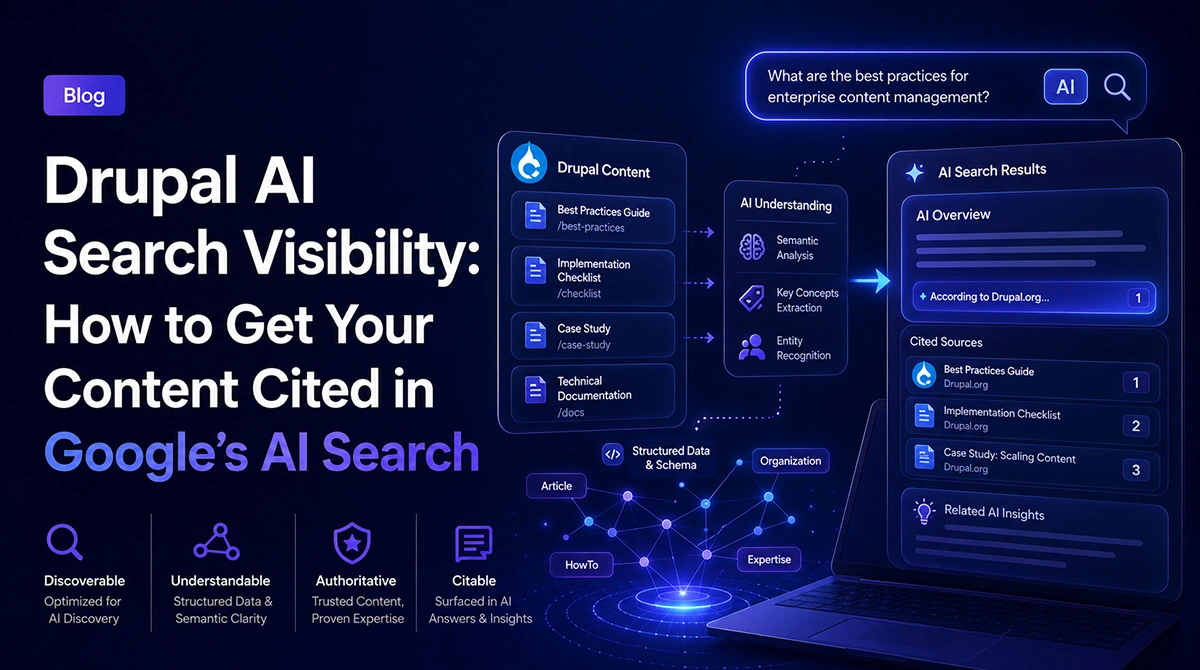
By the BinaryWorks Drupal and AI team. Certified Drupal engineers and AI specialists building enterprise sites since 2009. Last updated June 2026.
Open Google today and, for a lot of questions, you never reach the blue links. The answer is already sitting at the top of the page, stitched together by AI from the sources it decided to trust, and your link waits below the fold, unclicked. For the universities, agencies, health systems, nonprofits, and enterprise teams we work with on Drupal, that one change rewrites the brief. The question stopped being “where do we rank.” It became “when the AI answers for us, does it name us or leave us out.”
In May 2026, Google finally spelled out how AI search works, and the punchline caught out a lot of teams who had spent the year bracing for something exotic: optimizing for AI search is still SEO. No separate algorithm. No special file to feed the machines. No new department to staff. The work is structural, and if you run Drupal, most of it is already in your platform waiting to be configured. You are not rebuilding. You are tuning what you already have.
Here is what actually changed, what Google asked for, and the specific moves that get a Drupal site cited instead of skipped.
AI search visibility, defined
AI search visibility is how easily your content can be found, lifted, and credited by AI search experiences: Google’s AI Overviews and AI Mode, plus assistants like ChatGPT and Perplexity. It is SEO carried into the AI era. You will hear it called Generative Engine Optimization (GEO) or Answer Engine Optimization (AEO), and both describe the same aim, which is being the source an AI names inside its answer. Google’s May 2026 guidance is blunt that neither is a separate track from SEO.
Key takeaways
- AI search is still SEO. Google raised the bar on the basics; it did not invent a new game.
- The standard moved from publishable to citable: content an AI can pull a clean answer from and credit to you.
- Nothing happens until a page is retrievable. If it cannot be found and read, it cannot be cited.
- Depth, structure, a named author, and real evidence get cited. Thin, anonymous pages get passed over.
- Google named specific things to stop paying for, including AI-only schema, FAQ markup as a visibility play, and llms.txt files.
- On Drupal, all of this is configuration and content modeling, not a replatform.
How AI search changed the rules for Drupal sites
For most queries, the search now finishes on the results page, which means the contest is decided before anyone can click. Four things shifted at once. AI Overviews drop a written answer above the links, built only from pages Google has already indexed and trusts. AI Mode goes further and turns the search into a back-and-forth that never needs your site. Zero-click became the rule rather than the curiosity. And people stopped typing fragments; they ask whole questions now, so the page that answers the exact question is the one that surfaces.
None of this is a niche habit. McKinsey’s State of AI in 2025 puts regular AI use at nearly nine in ten organizations. The people sizing up your programs and services have folded AI into how they look anything up. The front door changed even though your content did not.
So every query splits into one of two outcomes.
| Displaced | Cited | |
|---|---|---|
| What happens | The AI answers; your link goes unclicked | You are the named source, and the visit arrives |
| Your position | Absent from the decision before it starts | Present, credited, and trusted |
| Traffic quality | Lost entirely | Higher intent; the reader arrives informed |
| Root cause | Pages AI cannot find, read, or trust | Visible, organized, first-hand content |
The distance between those two columns is structural, not a writing problem. You rarely close it with better adjectives. You close it by being findable, easy to extract, and clearly attributable. Unglamorous, and entirely within your control.
What Google’s May 2026 AI search guidance actually says
Strip it down and Google gave three things to do and one thing to stop, all resting on a single idea: there is no AI algorithm hiding behind the curtain. After a year of teams rewriting copy “for AI,” minting new file formats, and hiring answer-engine specialists, the official verdict was that most of that work was beside the point. Whatever decides what AI cites is the same machinery that has always decided what ranks.
It helps to watch it run. Someone searches “best universities for environmental policy research.” Google pulls pages it has already indexed and ranked, breaks the question into related ones such as faculty, outcomes, and funding, and assembles the answer from whatever it can find for each. A page it cannot find or rank was never in the running. Swap the student for a donor, a patient, or a procurement lead and the sequence is identical.
| Area | What Google asked for |
|---|---|
| Technical | Every page indexed, crawlable, and eligible to appear with a snippet |
| Content | Unique, first-hand, non-commodity content, clearly organized, with images and video |
| Experience | Good page experience across devices, with clear, readable structure |
| Stop | A short list of specific tactics named as unnecessary for AI search |
The chain is worth memorizing: not retrievable, so not citable, so not visible. Miss the first gate and nothing downstream matters.
Publishable versus citable: the line that decides visibility
The bar is no longer whether you published something. It is whether an AI can pull a clean answer out of the page and credit it to a named, credible source. Most organizations are drowning in the first kind of content and starved of the second, and the gap between them is specific and easy to test.
| Publishable | Citable |
|---|---|
| Exists on a live page | Indexed and accessible to crawlers |
| Written by someone at your organization | Carries a named author with stated expertise |
| Covers the topic | Answers a specific question in the first sentence |
| Looks well formatted | Uses labeled sections an AI can extract cleanly |
| Published on time | Updated, with a visible date |
Why this should worry a budget owner: your audience builds its shortlist before you ever hear from them. Forrester’s buyer research found that 62% of business buyers can set their selection criteria or finalize a vendor list on digital content alone, with no conversation required. If an AI is assembling that list and your pages are not citable, you lose in a round you never see.
There is a quick gut check for any page that matters. Cover the navigation and the title in your mind, then ask whether an AI could still tell what the page is and who it is for. Is the answer in the first sentence or hiding in the fourth paragraph? Does the page name a credible author, or read as if no one wrote it? One “no” and the page is effectively invisible to AI, however sharp it looks to a person.
Fix 1: Make your Drupal content retrievable
Retrieval comes first because nothing else can rescue a page that cannot be found, which is also why it tends to hold the quickest wins. Four problems cause most of the avoidable damage, and each is a Drupal setting rather than a development project.
A stray “no-index” left over from staging can bury a whole section weeks after launch; an agency ships its benefits and eligibility pages, then watches impressions sit at zero because nobody cleared that one flag. A site dragging tens of thousands of legacy URLs burns its crawl budget on pages that will never be cited. Content that only assembles after JavaScript runs can look finished to a visitor and nearly empty to a crawler. And the same article living at five URLs splits its own authority until no version wins.
| Issue | Risk chain | Drupal-native fix |
|---|---|---|
| Indexability | Page exists, not indexed, not retrieved, not cited | Remove dev-era blocks; confirm key pages are indexable; submit a clean sitemap |
| Crawl budget | Low-value URLs crawled, budget wasted, key pages missed | De-index archives and utility pages; consolidate; trim the XML sitemap |
| JS rendering | Loads for visitors, blank for crawlers, not indexed | Serve critical content as server-rendered HTML; test with JavaScript disabled |
| Canonicals | Same content, many URLs, authority split | One permanent canonical URL per topic; redirect duplicates |
One thing worth doing this week: load your five most important pages with JavaScript switched off. If the substance vanishes, a crawler may be seeing the same emptiness, and that single test often explains a problem no amount of rewriting would have touched. This is ordinary Drupal development and configuration work, and clearing it before you touch content is what stops the rest of the effort from leaking away.
Fix 2: Make your content citable, not just published
Citable content puts the answer first, signs it with a real expert, breaks into labeled sections an AI can lift, and stands on first-hand evidence. This is usually where organizations are sitting on an advantage they have not cashed, because the expertise already exists; it is just trapped in PDFs, newsletters, and walls of prose.
Picture a nonprofit with fifteen years of program outcomes losing every AI citation to a smaller peer whose results happen to be structured and crawlable. The knowledge gap between them is nothing. The structure gap is everything. Three moves close it. Lead with what only you can say, the outcomes, the data, the named people, because generic explanation is a commodity and gets treated like one. Break content out for extraction, moving eligibility, steps, and results into their own labeled sections that each open with the answer. And pick depth over volume, because a handful of deep, evidenced pages beats a warehouse of thin ones almost every time.
| Before | After | |
|---|---|---|
| Volume | 120 pages, about 200 words each | 15 pages, 800-plus words each |
| Substance | Generic descriptions, no attribution | Outcomes data, named program directors |
| Maintenance | Published once, never updated | Updated quarterly with new results |
| Result | No depth signal, not cited | Cited across AI answers |
To find the gaps without guessing, run your priority queries through Google AI Mode, ChatGPT, and Perplexity, note where you are missing, and write down what the cited source has that you do not. Then look at whoever keeps getting named and list the questions their pages answer and yours dodge. Bring each gap up to the citable standard, and start with the ones only you can fill from first-hand knowledge, since those are the most likely to earn a citation.
Watch the session this article is based on
We walked through these fixes live, on real Drupal sites, in our on-demand webinar.
Watch the recordingFix 3: Earn the visit after the citation
A citation that drops someone onto a slow or broken page spends the authority that won it, so page experience is part of visibility, not a separate chore. A page cited in an AI Overview that takes seven seconds to load on a phone loses most of the people it is handed, and Google is watching what happens after the click. Core Web Vitals, mobile usability, and HTTPS are still real factors, so run PageSpeed Insights on your most-cited pages and clear the load-time and layout-shift issues before anything else.
This is also where money leaks quietly. Teams pour months into custom markup “for AI” and watch citations stay flat, because generative AI does not need structured data to read you. Keep schema where it earns real rich results in standard Search and put the rest of that energy into the content. Underneath all of it sit two old fundamentals that still pay: service and product pages that actually answer who it is for, what it solves, how it works, and what to expect; and entity consistency, so your name, description, and category line up across your own site, your profiles, and the wider web. Google believes what the web says about you when the web and you say the same thing.
What Google told teams to stop doing
Every hour spent on a tactic that does nothing is an hour stolen from one that works, and Google was unusually willing to name names. The list below is not our opinion; it is what the May 2026 guidance flagged as unnecessary for AI search.
| Stop doing this | Because |
|---|---|
| AI-specific schema markup | No structured data is required for generative AI |
| Rewriting content for an “AI tone” | Google rewards content written for people |
| Treating AEO and GEO as separate from SEO | Optimizing for AI search is still SEO |
| Publishing more pages to raise AI visibility | Fewer deep pages outperform many thin ones |
| Chasing “guaranteed” AI Overview placement | Google does not guarantee inclusion |
| Building llms.txt files to feed AI | Crawlers treat them as ordinary text files |
| Pre-chunking content for AI | Google extracts the right passage on its own |
Two of these deserve a planning note. On May 7, 2026, Google removed FAQ rich results from search outright, so FAQ schema is done as a visibility tactic; the content still earns its keep, so turn those pages into labeled sections that answer real questions. And on agentic search, where AI agents read a page through screenshots and the accessibility tree, Google’s advice is to bother only if it is relevant and you have spare capacity, because everything above already makes you agent-ready. Same investment, not a new one.
How to measure AI search visibility
Measure it weekly and keep the receipts, because progress you cannot show is progress you cannot defend at budget time. Three tools cover the ground: Google Search Console for indexing, crawl, and click trends, PageSpeed Insights for Core Web Vitals, and a manual citation check across the AI tools for your priority queries.
| Fix area | What to measure | Tool |
|---|---|---|
| Indexability | Excluded-pages count | Search Console |
| Crawl budget | Pages crawled per day | Search Console |
| Rendering | Crawled vs. indexed gap | URL Inspection |
| Canonicals | Indexed URLs per topic | Search Console |
| Content | Click-through rate on target pages | Search Console |
| Experience | LCP and CLS on cited pages | PageSpeed Insights |
| AI citation | Five priority queries, weekly | AI Mode, ChatGPT, Perplexity |
The citation check is the most honest number you have. Once a week, run your five highest-value queries through the major AI tools, note who gets cited, and screenshot it. Where you are absent, work out what the named source has that you lack and send that straight back into the content. Rankings hint at potential. Citations are the proof.
Your 90-day plan to get cited
The order is the plan: diagnose, fix retrieval, restructure the content that matters, then measure, in that sequence, because you cannot be cited before you can be found. A short list of priority pages beats a sitewide scramble, and for most Drupal teams the first citations show up inside the quarter.
| Phase | Weeks | Focus |
|---|---|---|
| Diagnose | 1 to 2 | Search Console audit, crawl report, citation check on 10 priority queries |
| Fix retrieval | 3 to 5 | Indexability, crawl budget, canonical URLs, HTML delivery confirmed |
| Fix content | 6 to 9 | Five priority pages restructured: labeled sections, depth, named authority |
| Measure and embed | 10 to 12 | Weekly citation check, AI Overview tracking, Core Web Vitals review |
See exactly where your Drupal site stands
A focused AI Search Readiness Audit reviews indexing and crawl health, content structure, duplicate and canonical issues, mobile performance, and your markup, then tells you which fixes will move your citations fastest.
Get Your Free AI Search Readiness AuditWhy Drupal is built for this
Drupal’s content model is the reason none of this needs a replatform. Fields, structured content types, taxonomy, and clean URLs are exactly the levers that make a page easy to extract and easy to consolidate, and the same model that produces citable answers quietly improves internal linking, accessibility, and personalization down the line. If you want a hand turning the guidance into actual configuration, that is the daily work of our AI-powered Drupal solutions and Drupal services teams, and you can see how we approach digital and AI growth across the board at BinaryWorks.
Frequently asked questions
Is optimizing for AI search different from SEO?
No. Per Google’s May 2026 guidance, optimizing for AI search is still SEO, and there is no separate algorithm. The basics of retrievability, quality, structure, and page experience got more important, not replaced.
How do I get my content cited in AI search?
Make each priority page citable: lead with a direct answer, sign it with a named expert, break it into labeled sections, back it with first-hand data, and confirm the page is indexable and fast. Then check weekly whether the AI tools name you for your priority queries.
Do I need an llms.txt file for AI search visibility?
No. Google’s guidance says crawlers treat llms.txt as an ordinary text file, with no special pathway. The effort is better spent making existing pages retrievable and citable.
Does schema markup help my content appear in AI Overviews?
Only indirectly. There is no AI-specific markup that lifts generative visibility on its own. Keep structured data where it earns standard Search rich results, and treat content quality and structure as the real levers.
How do I know if AI is citing my content?
Run your most important queries through Google AI Mode, ChatGPT, and Perplexity and see whether your site shows up as a source. Do it weekly and screenshot it; a recurring absence on a high-value query is a direct signal to restructure that page.
Can Drupal handle AI search optimization without a rebuild?
Yes. Nearly every fix is configuration and content modeling: indexability, canonical URLs, server-rendered HTML, labeled fields, and page experience. Drupal’s field and content-type model is well suited to producing citable, extractable content on your existing build.
The Bottom Line
AI search did not hand you a new game to learn. It raised the stakes on the basics and boiled the whole thing down to one question: can an AI find your page, pull a clear answer from it, and put your name on that answer. For a Drupal organization the route to yes is structural, ordered, and doable on the platform you already run. Fix retrieval, make the pages that matter citable, earn the visit, and check your citations every week. The teams that move on the fundamentals first are the ones the AI ends up naming.