

A president of a graduate institution gets asked a question almost every higher ed leader is wrestling with right now: Is AI a threat to education, or is it a tool that can make education better?
The easy response is to pick a side. The harder and more useful response is to sit in the tension. That is exactly what Thomas, President of Southwestern College in New Mexico, does in this conversation. He does not reduce AI to panic or promise. He talks about leadership, student expectations, relational work, institutional trust, and the responsibilities colleges now carry as AI starts reshaping how students learn, search, choose, and engage.
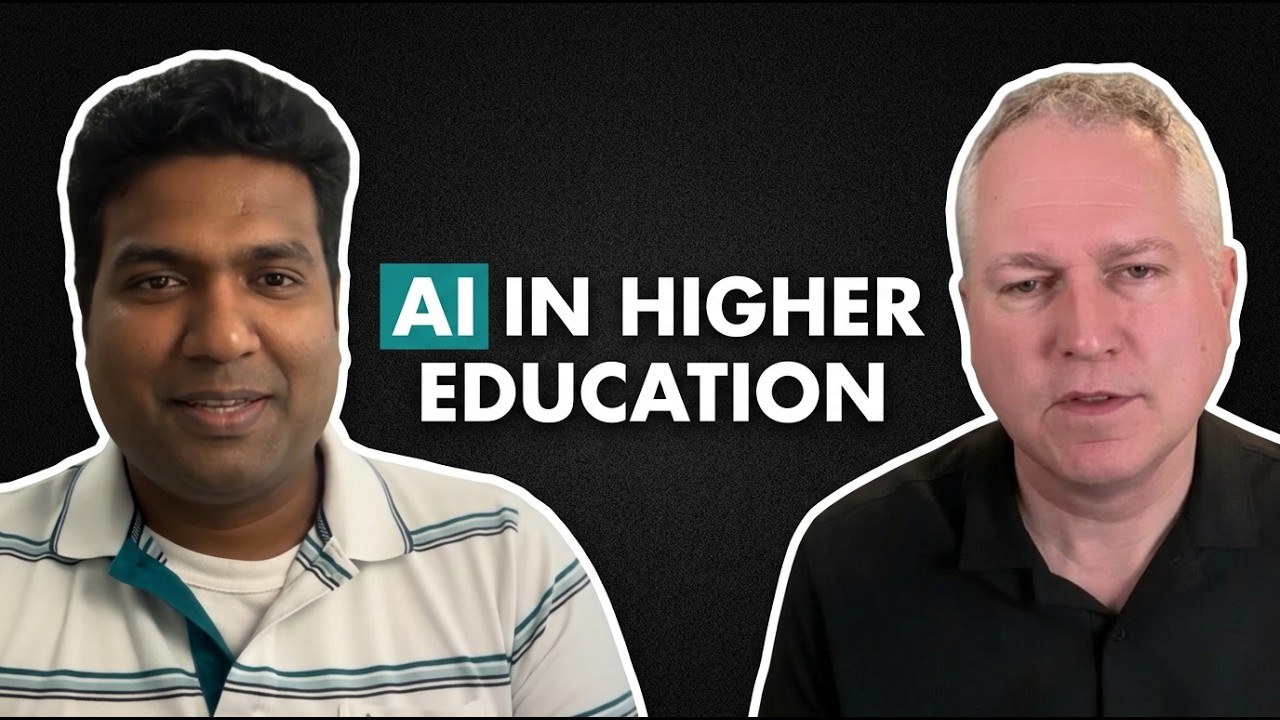
In this episode of AI Talks, Sathish Kumar Mariappan speaks with Thomas about servant leadership, how student decision-making has changed, why AI should amplify rather than replace human work, how websites and enrollment journeys are shifting, and where colleges still overcomplicate systems that should be simpler. The conversation is practical, thoughtful, and grounded in lived experience across decades of higher education leadership.

Thom D. Chesney
Thom D. Chesney is President of Southwestern College in Santa Fe, New Mexico. A three-time college president, he brings 30+ years of higher education leadership shaped by servant leadership, people-first values, and experience across community colleges, Catholic universities, and graduate institutions.

Sathish Kumar Mariappan
Sathish Kumar Mariappan is Co-Founder of Drupal Partners, an Atlanta-based certified Drupal agency. He helps education, government, healthcare, and enterprise organizations with Drupal development, migration, AI consulting, and digital strategy, building secure, scalable digital experiences across complex ecosystems.
Episode TL;DR
- → Thom's leadership philosophy is rooted in servant leadership: the person in front of you is the most important person in the room, not you, regardless of your title. That principle directly shapes how he approaches AI adoption.
- → Higher education's perceived value has shifted dramatically over 40 years. What was once an unquestioned expectation is now debated at every conference table.
- → Students today decide based on three things: how flexible the delivery is, how transparent the cost is, and how clearly the program connects to a career outcome.
- → AI should amplify relational work, not simulate it. The strongest use case Thom sees is AI handling the administrative burden so humans can spend more time in genuine connection.
- → Early-career professionals face a real danger if they treat AI as a shortcut before building their own critical thinking and judgment.
- → Universities are in a mixed state. Some are moving thoughtfully. Many are stuck trying to respond to AI and regulatory shifts simultaneously with limited staff and budgets.
- → Two of the most overcomplicated processes in higher education, course scheduling and financial aid packaging, are prime candidates for AI-driven simplification.
The Foundation: Servant Leadership Shaped Long Before the Title
The conversation opens with Sathish asking what has shaped Thom's leadership philosophy across three decades and three presidencies.
Thom: "So much of it is shaped even before we think that we're in leadership positions. What are the situations we were put into growing up as children, getting into different spaces or invitations where we got access to other leaders."
Thom: "What I saw at the time and didn't necessarily have a term for it would have been what we would very commonly call servant leadership. Always in that space of putting the others that you're working with, you're leading, being led by, kind of in a position ahead of you or equal to you."
Thom traces this back to running cross-country. His coaches did not just instruct from the sideline. They ran alongside the athletes. That image, a leader willing to do the same work they ask of others, stuck with him through every role that followed.
Thom: "In the case of distance running, they ran alongside us. So it's like, hey, they're willing to do the same work I'm willing to do. Then later in life you realize that's a part of kind of who you are."
He has carried this into three different college presidencies: a community college, a small Catholic liberal arts university, and now a graduate-only institution. Each required different strategies, but the core orientation never changed.
Thom: "A form of altruism. Always understanding things are much bigger than your own. The person in front of you is the most important person in the room, not you, regardless of what your title or position might be."
This is not just biographical context. It sets up everything that follows. When a leader approaches AI through the lens of "how does this serve the people I'm responsible to?" the adoption decisions look very different than when the question is simply "how do we deploy this?"
40 Years on Campus: From Punch Cards to AI-Optimized Websites
Sathish: You've seen higher education for over 30 years. What has changed?
Thom: "Having been on a college campus for 40-some consecutive years starting as a student in 1984 to present, a lot has changed."
Thom: "Back in the '80s where I was growing up and coming out straight out of high school, there was just an expectation that everyone would participate as much as possible in some kind of postsecondary education. Something beyond high school was going to be of value, from apprenticeships, certificates, associates degrees, bachelor's degrees, all the way up to terminal degrees, professional degrees."
That cultural consensus has fractured. Thom describes sitting at a luncheon table at a recent conference where real skeptics argued that on-the-job training and informal credentials should be enough, while others insisted that a focused two-year program or a well-rounded liberal arts degree remained essential.
Thom: "I am one of those people who's in that space where I remember the analog world of higher ed and I'm now fully immersed in and continuing to learn from and lead in the digital world."
That perspective, holding both the analog memory and the digital present, gives him a grounding that many leaders navigating AI lack. He knows what was lost in each transition and what was gained.
Is your institution leading AI with intention or letting it shape decisions by default?
Higher ed leaders are rethinking student engagement, trust, and digital experience as AI reshapes the journey. This conversation explores how leadership, transparency, and purpose can guide that shift.
How Students Decide Now: Three Non-Negotiable Criteria
Sathish: How do today's students make decisions? How do they see the value of education differently?
Thom: "No two alike are making decisions the same way."
But across generations, across institution types, and across Thom's own campus where students range from their 20s to their 60s, three decision points keep surfacing.
Thom: "What is the program that you have, what are the courses, what is the content, how is it going to be delivered. Ever more so the focus on cost, what will it cost me, and the expectation that they can see that really transparently. And then the career piece. What does it get me? What do I get out of it? Is there something at the end of that?"
Delivery, cost, and career outcome. Students are no longer willing to accept whatever format or schedule the institution offers. They want hybrid options, evening and weekend sections, and asynchronous delivery that fits around work and family obligations.
Thom: "We used to proclaim as higher ed institutions, this is the way it's going to be. You're going to do this number of credits to get this type of degree in this amount of time. Here's when things are offered. Here's how they are offered. We see more of the student voice and perspective in that nowadays."
Thom also highlights something most institutions do poorly: learning from the students who looked and then chose somewhere else. What was the deciding factor? Was it cost, delivery mode, or a missing career connection? That feedback loop is essential, and most institutions are still not closing it.
AI as Amplifier: The Counselor Example That Reframes the Whole Debate
Sathish: What's your personal perspective on AI in higher education? Do you see it as risk or opportunity?
Thom: "I think it's all the things. I think we're in chapter one or the preface of the book that will be written about AI and higher ed."
Thom describes himself as a stereotypical Gen X member: curious, experimental, and wired to try new things. But the core of his answer lands on a question he gets asked constantly. Many of Southwestern College's students are pursuing degrees in mental and behavioral health. People want to know: will a therapist be replaced by an AI counselor?
Thom: "Will a therapist be replaced? I like to think of it as, will their work be amplified? Can AI amplify the relational work that we do rather than simulate it? How can it support rather than take the place of?"
He makes it concrete. A therapist currently splits their schedule between actual client sessions and the administrative documentation required by insurance companies: Medicare, Medicaid, private insurance. AI tools can handle transcription and note summaries, which means the therapist reclaims that time for actual therapy.
Thom: "If I'm not trying to plot into my schedule where am I going to catch up on all of my notes versus enough time to check and review the summaries or the notes that come from an AI tool, I can actually spend more time doing therapy, providing counseling, really developing the relationship that's needed there for healthy outcomes."
Thom: "AI helps us prepare for the human interactions that help us connect."
When AI Becomes a Shortcut: The Risk for Those Starting Out
Sathish: What about someone at the start of their career who goes straight to AI? Is there a risk factor?
Thom: "Absolutely."
Thom is transparent about the asymmetry. He has decades of personally written letters, appeals, thank-you notes, and stewardship communications that he can now feed into AI tools and ask for patterns, drafts, and ideas. That body of work is his. He built it. The AI is working from his foundation.
Thom: "Someone just coming in looking for ways to be effective, to be counted on as an employee, could very well look at using AI as a shortcut, as something to replace. And the risk in that is more than what we call AI slop."
The deeper risk is not just sloppy output. It is a generation of professionals who never develop the critical thinking, source validation, and ethical judgment that comes from doing the work themselves. Thom connects this directly to education.
Thom: "What we did for many, many years and still do is talk about doing research. Make sure to properly cite and attribute and know where your sources come from. Are those good sources for research? Are we using those same skill sets, that same kind of thinking in applying AI to the work that we do, so we don't just lean into it, adopt it, and not think about the ethics, moral issues, and even legalities thereof?"
Tool Overload: The App Explosion Parallel
Sathish: Do you think students are getting overwhelmed with all these tools?
Thom: "I think it's very easy to get overwhelmed, especially with the proliferation of tools right now."
Thom draws a direct parallel to an earlier cycle in higher education technology.
Thom: "I remember when the explosion of apps occurred. In the higher ed space everybody was creating their own institutional app for a while, and then realizing that over a period of time most people drifted back and just wanted a really good website that performed well on mobile and on a screen."
Thom: "My general advice is don't get overwhelmed by the noise, but be curious and go in and work with one or two. See what works for you."
Thom: "Narrow the focus and get good at one or two things. Come to understand it, hone it, give it some time, and you'll see where your comfort zone is. And you also may along the way come to believe in your own skill sets, your own critical thinking, your ability to make judgments."
Want the full context behind these insights?
Hear the complete discussion with real examples from higher ed leadership.
🎵 Listen to the full episode on Spotify →Leading with Purpose: Engagement Plus Listening
Sathish: What does leading with purpose mean in an AI-driven world?
Thom answers in two layers. First, personal engagement. A leader who is visibly using AI tools, sharing what they learn, and demonstrating curiosity builds a foundation of credibility.
Thom: "If I'm able to sit with my colleagues, my leadership team, our faculty at the college, and talk about my experiences, here's what I'm seeing, here's what I'm paying attention to, what I'm learning. That's a first level of relationship and I think trust in the work."
Second, institutional listening. Purpose-driven leadership in this moment requires going beyond your own learning and hearing what is happening across the full campus.
Thom: "It's twofold. Authentic engagement, being involved, taking part in the learning. But then really getting the full scope at my own college of what are our interactions, how are we engaged or not engaged in the use of AI, and what does that mean for policy and practice and process at our own campus."
Leadership in this environment is not about having the answers. It is about being present enough to ask the right questions and connected enough to hear what people across the institution are actually experiencing.
The Mixed Bag: Where Universities Actually Stand
Sathish: Do you think universities are preparing students well for this new reality?
Thom: "I think it's a very mixed answer."
Some institutions are moving with both speed and thoughtfulness, adopting AI policies, embedding AI into classrooms, and building AI-focused credentials. Thom notes that some schools are beginning to integrate AI literacy into traditionally non-technical programs.
Thom: "If there's a changing regulatory environment at the same time as there's a wildly evolving IT landscape in the case of AI, it's hard to do both, especially with the staff that you have, the faculty that you have, the limited resources that you have."
This is the real constraint. It is not lack of awareness. It is capacity. Institutions with limited staff, shifting regulations, and tight budgets are being asked to transform on multiple fronts simultaneously. The ones that succeed will be the ones that prioritize rather than trying to solve everything at once.
Who Thrives Next: Curiosity and the Willingness to Evolve
Sathish: What kind of students or leaders will succeed in the next five to ten years?
Thom: "Those that continue in the widest sense to be lifelong learners."
He shares the story of a Southwestern College graduate from 20 years ago who is a practicing counselor. This graduate is now using AI to handle clinical note-taking and insurance documentation. He was not forced into it. He chose to stay open, explore the tools, and adapt his workflow.
Thom: "It's kind of like those who shunned Microsoft Office suite a long time ago and just said, 'No, I'd rather just continue to do things handwritten.' Well, the opportunities really dropped when everybody needed to have some familiarity with word processing tools."
Thom: "The people who remain curious and explore and experiment I think are going to be in a better and more adaptable and flexible position with the work that they get to do."
Enrollment and Websites: AI Is Already Reshaping the Front Door
Sathish: Do you think websites will still matter for enrollment, or will students use tools like ChatGPT and Claude to decide?
Thom: "We're already seeing it."
Southwestern College is in the middle of its first full website redesign in about 12 years. The approach is shaped directly by how AI now surfaces information.
Thom: "We have probably scaled about 75% of prior pages away from that migration. We're paying attention both to search engine optimization and AI optimization."
The new site is designed around a principle: do not bury information behind layers of pages. Give the visitor what they need immediately, then let them choose their preferred way to continue the conversation.
Thom: "Do you want to start texting with someone? We can do that. Do you want to get in an email with us? You can do that. Do you want to visit campus physically or do a virtual tour from wherever you are? We can do that. Do you want a phone call? We can do that."
Thom also surfaces a fascinating paradox about how prospective students use AI in their search process.
Thom: "Some of them are using it to find, paradoxically, what's real. Our education is very experiential, very relational. I can use AI to find a very experiential, relational graduate program in therapy or counseling and have Southwestern come up for that."
Students use the most advanced digital tool available to find the most human educational experience possible. That tension is something every institution should be paying attention to.
Student Retention: AI Triggers the Conversation, Humans Have It
Sathish: Do you think AI can help track student progress and predict dropouts?
Thom: "It's already available and I think being adapted."
The use case is straightforward: AI analyzes student engagement data and flags when someone appears to be falling behind, which triggers outreach from a real person.
Thom: "How do we crawl across student data and maybe see some alerts that see someone's falling behind in a certain way? And that triggers an outreach from a course navigator, a mentor, someone in the advising department."
Thom: "It's imperfect, and we would expect that. Just like AI is imperfect in diagnosing radiological scans, it's also going to be imperfect for early alerts."
But imperfect is still valuable if it leads to a human conversation. A student's car broke down. A student had a child. A student lost their job. Those are not problems AI can solve. They require a person who cares enough to check in and help find a path forward.
Thom: "If they've said we are high-touch, we are human, and they start using some of these tools, they're going to need to be able to articulate how they're using those, why they're using those, so that they don't come off as being inauthentic."
Risks and Compliance: No Surprises
Sathish: What risks or compliance issues should universities watch for?
Thom: "One of the most obvious risks is, are they really clear in the way in which they're communicating the way they're using student data?"
Thom's principle is simple: a student should never be caught off guard.
Thom: "A student should not be surprised if a faculty member says it appears that you may have used artificial intelligence to help you write 55% of this paper. And that's the first time a student is learning that those tools are being used to check their work. It should never be the first time."
The transparency requirement extends in every direction. Are third parties accessing student data? Are AI-generated reports to accrediting bodies being validated for accuracy? Are enrollment numbers and student demographics reported to state and federal agencies being verified?
Thom: "In some cases, individual decisions are being made. Let's try this, let's use this. But who should know when those adoptions are being made, when those decisions are being made, is a critical component."
What Universities Still Overcomplicate
Sathish: What do universities still overcomplicate?
Thom picks two processes that are ripe for AI-assisted simplification.
Course Scheduling
Thom: "Right now in many, many institutions that's a very manual process. How helpful would it be to use AI to look at some of that same information and create some scenarios?"
He draws a comparison to how professional sports leagues schedule entire seasons using algorithmic modeling that accounts for logistics, travel, and conflicts.
Thom: "The same way that professional sporting organizations run multiple sets of how to book the schedule. That's based on a whole lot of logistics, locations, travel, scheduling conflicts. Do the same thing in higher ed. Really look at our student data. Look at where students are progressing. And run some scenarios in minutes that could take hours for someone who's focused on trying to do that scheduling in a manual way."
Financial Aid Packaging
Thom: "The financial aid process, I think a lot of people would celebrate if we could streamline that. Make it smoother to gather the information. Can we more quickly begin to package and make offers of aid, grants and aid, loans, all the different types of aid that might be available to a student so they can make their decisions more thoughtfully and have more time to decide amongst institutions?"
Thom: "None of that's excluding human participation or things like shared governance. It's really just some efficiencies, back work, a lot of back work."
Final Advice: Be Curious, Engage Others, and Don't Be Surprised
Sathish: One piece of advice for leaders navigating this change?
Thom: "Stay really curious and open. Reading and exploring and experimenting widely. And don't be overwhelmed by all that's out there."
Thom: "In a manageable kind of way, be paying attention. Rather than assuming it, pay attention to it, and not be surprised by it. Because in my role, and I think many of our roles, people are going to come to you and expect you to know something."
But personal learning is only half the equation. The other half is engagement across the institution.
Thom: "Get in with your colleagues at all levels. In the business office, those that are teaching in the faculty. Talk to your people in operations, grounds crew and other spaces. You might be surprised. People that are taking care of our landscaping, for example, are using AI tools to help determine, in combination with weather forecasts, when to water, when not to water, when to anticipate we'll be doing water collection. It's Santa Fe after all."
The image is striking: a college president learning about AI adoption from the grounds crew. It is servant leadership in practice, and it is exactly the kind of cross-institutional curiosity that will separate the leaders who navigate this transition from the ones who are caught off guard by it.
What Higher Ed Leaders Should Do Now
AI is already reshaping how students choose, experience, and complete their education. Institutions that act now will be positioned to lead. Those that wait will face harder choices later.
- Use AI yourself before asking anyone else to adopt it. The credibility to lead this transition comes from personal experience, not policy memos.
- Frame every AI adoption as amplification. Ask whether the tool frees people to do more relational, human work. If it does, move forward. If it just automates for the sake of automation, reconsider.
- Close the student feedback loop. Find out why prospective students looked at your institution and chose somewhere else. Delivery, cost, and career outcomes are the three levers. Know which one you are losing on.
- Teach AI literacy with the same rigor as research methodology. Source validation, ethical reasoning, and critical thinking need to be embedded in AI education from the beginning, not bolted on after adoption.
- Be transparent about every AI tool in use. No student, faculty member, or staff member should be surprised by how AI is being used on their data or in their evaluation.
- Start simplifying the back office. Course scheduling and financial aid packaging are manual processes that consume enormous staff time. AI can generate scenarios and streamline workflows without removing human judgment.
- Engage across the full institution. AI adoption is not just a classroom or IT issue. It is happening in admissions, operations, advancement, and grounds. Leaders who listen at every level will make better decisions.
- Pick one tool and go deep. Resist the urge to try everything. Choose a tool that aligns with your institutional infrastructure, learn it thoroughly, and build the judgment to evaluate what comes next.
Ready to Build an AI-Ready Digital Campus?
At Drupal Partners, we help universities and institutions navigate AI-driven digital transformation with secure, scalable solutions:
- • Building AI-enhanced Drupal platforms that support institutional readiness and governance frameworks
- • Developing secure, high-performing digital experiences for education, from student portals to faculty systems
- • Integrating AI-powered tools into existing Drupal ecosystems for operational efficiency and personalized learning
Keep the Conversation Going
This is AI Talks #3 by Drupal Partners, inside stories and strategies from leaders navigating the shift to AI, automation, and the digital infrastructure they require.
Also Watch: AI Talks #2 — AI in Higher Education: Transforming Student Engagement and Enrollment →