

Claude Enterprise vs Claude Code vs Cowork: Which Does Your Team Need?
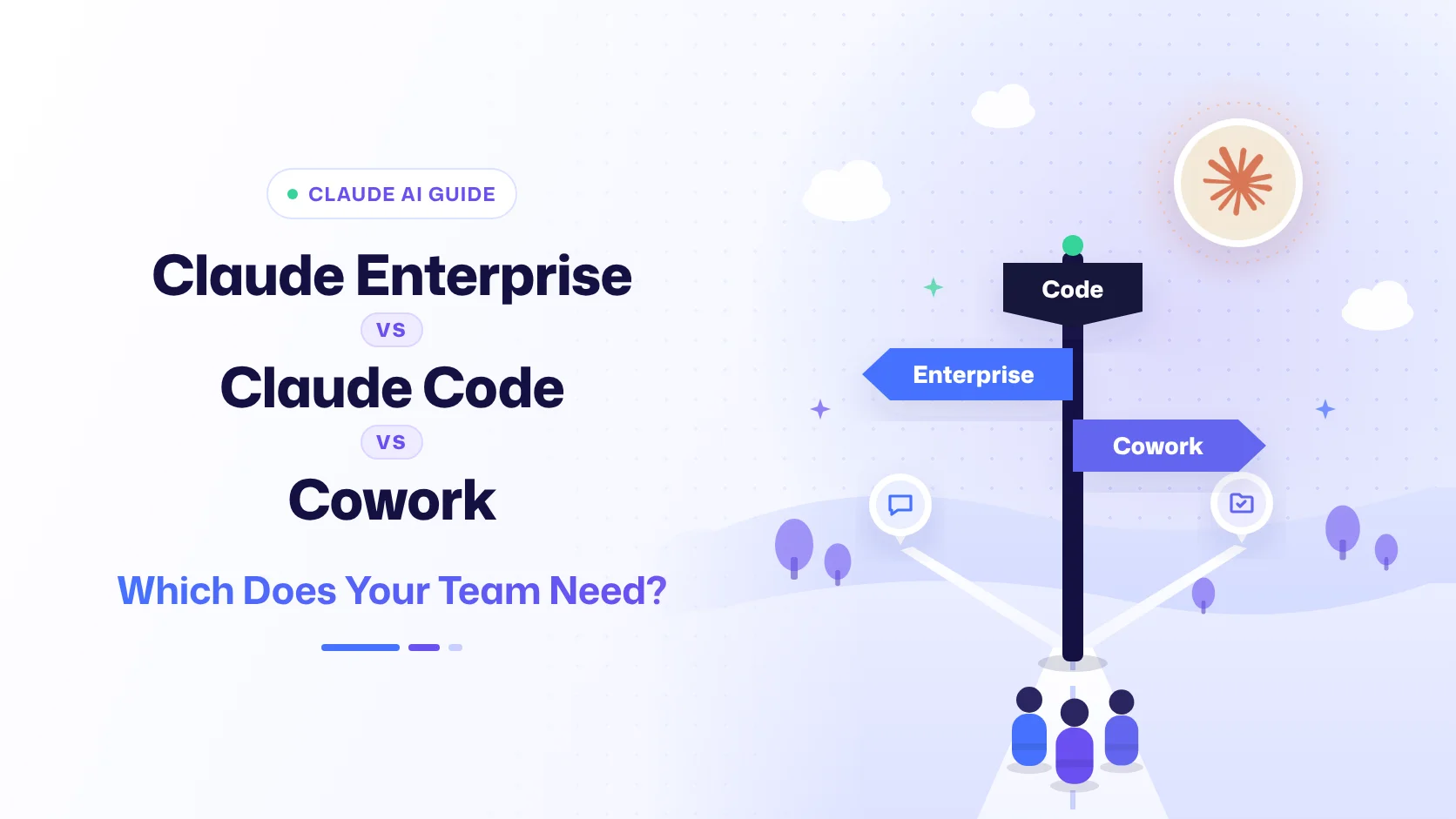
- Claude Enterprise is the company-wide Claude workspace with the security and admin controls large organizations need.
- Claude Code is an agentic coding tool for software teams. It reads, edits and runs code.
- Cowork brings that same agentic approach to everyday knowledge work, handling multi-step tasks across files and connected tools.
- Most companies need a mix: Enterprise for everyone, Claude Code for engineers and Cowork for teams with repeatable, multi-step work.
The short answer
If you only remember one thing, remember this: Claude Enterprise is the plan, while Claude Code and Cowork are ways of working with Claude. Claude Enterprise decides who gets access, how data is handled and what admins can control. Claude Code and Cowork decide what Claude can actually do for a specific person.
That is why the question “Claude Cowork vs Claude Code” comes up so often. Both are agentic, meaning Claude plans and carries out several steps instead of answering one prompt. The difference is who they are built for. Claude Code is built for developers working in code. Cowork is built for everyone else.
What Claude Enterprise is
Claude Enterprise is Anthropic’s plan for organizations that need Claude across many teams with central control. It gives every employee access to Claude in the browser and desktop apps, and gives IT and security teams the controls they expect from any enterprise software.
In practice, Claude Enterprise is where you set up:
- Identity and access: single sign-on, user provisioning and role-based permissions.
- Shared knowledge: projects that hold team documents and instructions so everyone starts with the right context.
- Connectors: links to business tools so Claude can read from the systems where work happens.
- Admin and data controls: usage visibility and settings for how data is retained and handled.
Exact features, limits and plan terms change as Anthropic updates its offering, so always check the current plan details with Anthropic or your partner before you sign.
Who it is for: every knowledge worker in a company that wants one governed Claude workspace instead of scattered personal accounts.
What Claude Code is
Claude Code is Anthropic’s agentic coding tool. Developers use it in the terminal, inside their IDE, in the desktop app or on the web. Instead of suggesting a line of code, it can explore a codebase, plan a change, edit multiple files, run tests and explain what it did.
For engineering leaders, the value is less about autocomplete and more about delegation. A developer can hand Claude Code a well-scoped task, such as fixing a bug, writing tests or updating an integration, and review the result.
When you roll Claude Code out to a team, the work is mostly about guardrails: which commands it may run, which repositories it can touch, shared settings across the team and how you will measure the impact.
Who it is for: software engineers, data engineers, DevOps and IT teams who work in code every day.
What Claude Cowork is
People search “what is Claude Cowork” more than almost any other Claude question, and for good reason. Cowork takes the agentic approach that made Claude Code popular and applies it to knowledge work. It runs in the Claude desktop app. You give it a goal, it works through the steps, and it uses the files and connected tools you allow it to use.
Typical Cowork tasks look like this:
- Pull figures from several spreadsheets and draft a monthly operations summary.
- Organize a folder of supplier documents and produce a comparison table.
- Turn meeting notes and a template into a client-ready proposal draft.
- Research a topic across sources and produce a briefing document.
Who it is for: operations, finance, marketing, HR, customer service and any team whose work involves several steps, several files and a predictable output.
Side-by-side comparison
| Claude Enterprise | Claude Code | Cowork | |
|---|---|---|---|
| What it is | Company-wide plan and workspace | Agentic coding tool | Agentic workspace for knowledge work |
| Main users | Everyone | Engineers and technical teams | Business teams |
| Where it runs | Browser and desktop apps | Terminal, IDE, desktop and web | Claude desktop app |
| Typical work | Chat, research, writing, analysis | Code changes, tests, debugging | Multi-step tasks across files and tools |
| Key setup work | SSO, roles, projects, connectors | Permissions, repo access, team settings | Workflow design, tool access, limits |
| How you measure it | Active users, tasks moved to Claude | Cycle time, review time, throughput | Hours saved per workflow |
Claude Cowork vs Claude Code: the real difference
Both tools let Claude act on your behalf. The difference is the environment and the audience.
- Claude Code works in a codebase. It understands programming languages, runs commands and fits into developer workflows such as pull requests and tests.
- Cowork works in a business workspace. It handles documents, spreadsheets and connected business tools, and it is designed for people who never open a terminal.
A simple rule: if the output is code, use Claude Code. If the output is a document, a spreadsheet or an update in a business tool, use Cowork.
Claude chat vs Cowork
Regular Claude chat is a conversation. You ask, Claude answers, you ask again. It is perfect for quick questions, drafting and thinking through a problem.
Cowork is delegation. You describe the outcome and Claude carries out the steps, checking in where you have asked it to. Use chat when you want to stay in the loop on every turn. Use Cowork when the task has a clear goal and several steps you would rather not do by hand.
Claude Team vs Enterprise
Anthropic also offers a Team plan. In general, Team suits smaller groups that want shared Claude access with basic administration. Enterprise suits organizations that need stronger identity, security and data controls, larger deployments and support for integration with company systems.
If you have a security review process, regulated data or more than a few departments involved, Enterprise is usually the better fit. Plan names, seat minimums and features change, so confirm the current details before deciding.
How to choose your mix
Here is the approach we use with clients during a Claude implementation:
- Start with Claude Enterprise for everyone who writes, reviews, researches or analyzes as part of their job. Set up SSO, projects and connectors first.
- Add Claude Code for engineering once permissions and shared settings are agreed. Take a baseline of cycle time before launch so you can show impact.
- Pick two or three Cowork workflows with clear inputs, clear outputs and a few hours of manual effort each week. Prove them, then expand.
- Govern all three the same way. One set of access rules, one audit trail and one owner. AgentixBox adds approval gates for any action that touches live systems.
Which mix fits your industry
The right combination depends as much on your sector as on your team structure. Here is what we typically recommend for the industries we work with most.
- Financial services: Claude Enterprise first, with strict data policies and audit logging. Cowork follows for recurring reporting and document review. Claude Code goes to engineering and data teams once repository rules are agreed.
- Manufacturing: Claude Enterprise for work instructions, quality documentation and supplier communication. Claude Code is often the fastest win for teams maintaining ERP, MES and plant integrations.
- Higher education: Claude Enterprise for staff across admissions, student services and research administration, with clear rules on student records. Cowork suits offices that produce regular reports and communications.
- Healthcare: start with administrative use cases in Claude Enterprise, configured around your compliance obligations and your Anthropic agreement. Expand to Cowork for document-heavy back-office work once governance is proven.
- Retail: Cowork shines for product content, merchandising analysis and promotional planning. Claude Code helps ecommerce and integration teams move faster.
Whatever the sector, the pattern holds: one governed workspace for everyone, and specialist tools for the teams that will use them every day.
Frequently asked questions
Is Claude Cowork the same as Claude Code?
No. Both are agentic, but Claude Code is built for software development in a codebase, while Cowork is built for knowledge work across files and business tools in the Claude desktop app.
Do I need Claude Enterprise to use Claude Code or Cowork?
Not necessarily, as Anthropic offers these tools on several plans. For company-wide use with central security and admin controls, most organizations choose Claude Enterprise. Check Anthropic’s current plan details for availability.
Which Claude product should a non-technical team use?
Start with Claude chat inside Claude Enterprise for everyday questions and drafting, then add Cowork for repeatable multi-step tasks such as reports, document comparisons and research briefs.
Can one partner implement all three?
Yes. BinaryWorks is an official Anthropic partner and implements Claude Enterprise, Claude Code and Cowork together, with one governance model and AgentixBox prebuilt agents and connectors.
Karthik Kalimuthu
Karthik Kalimuthu writes for BinaryWorks. BinaryWorks is an official Anthropic partner helping US organizations implement, govern and run Claude. Since 2009, 500+ projects delivered.
Keep Reading
- Claude Implementation Services: We roll out Claude Enterprise, Claude Code and Cowork in weeks.
- How to Roll Out Claude Enterprise: A practical 60-day plan with owners and checkpoints.
- AI Agent Governance: Approval gates, audit trails and who signs off.